Добро пожаловать в HavenseeK Рыболовные снасти

Tuna Circle Hooks vs. Trolling Hooks: The Ultimate 2026 Buyer’s Guide for Commercial Fleets
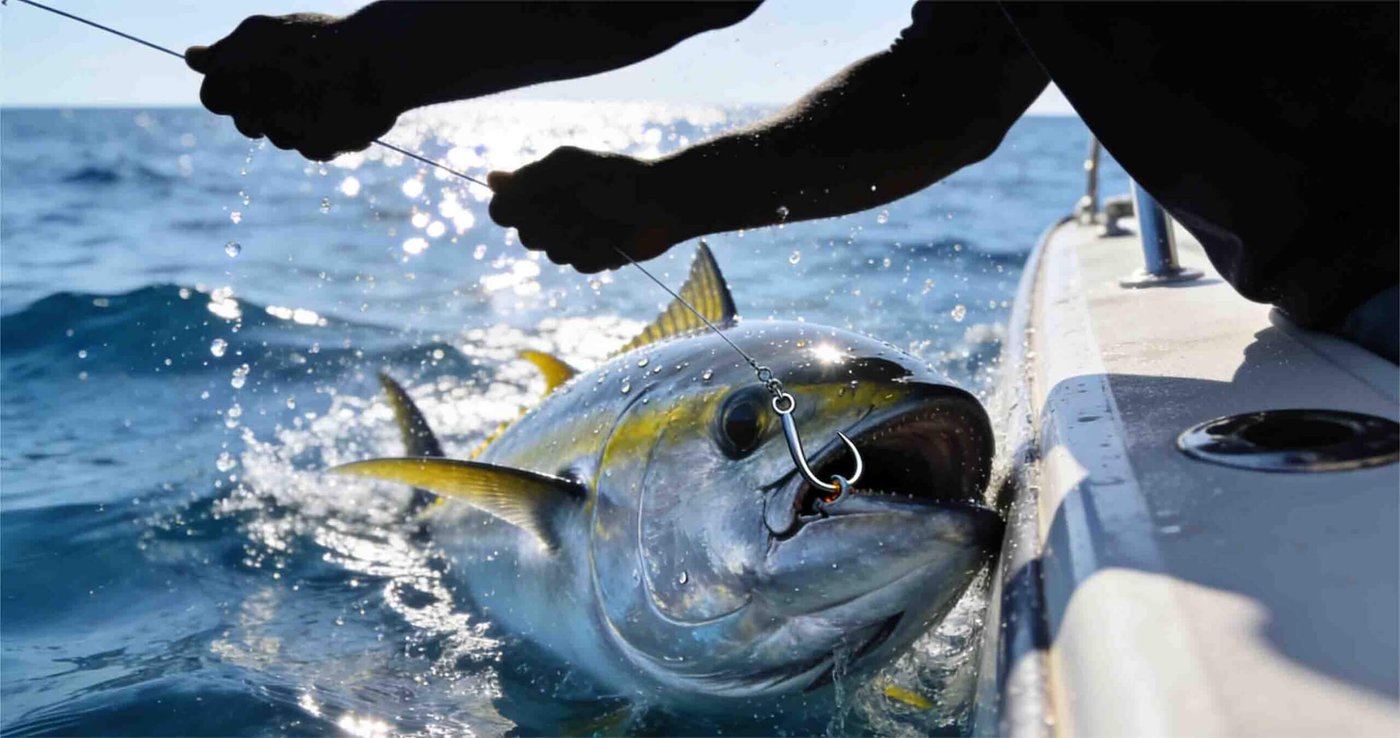
You’re trolling at 8 knots, the water explodes, and the reel screams. You fight for three minutes — then the line goes slack. The hook pulled. Another lost fish. If you’ve spent any serious time chasing tuna, you know that heartbreak all too well. The difference between a full kill box and a story about “the one that got away” often comes down to one piece of terminal gear: your tuna circle hooks.
Over the past 18 months, I worked alongside three veteran captains and two deckhands — together we’ve logged more than 50 years on the water — to put a range of tuna trolling hooks through the wringer. Our mission? Find the absolute best tuna circle hooks for high-speed scenarios, where most standard hooks fail. This article shares our raw field data, honest comparisons, and real-world lessons so you can make the right call before your next trip.
We tested hooks from different manufacturers, including premium products from a specialized tuna hook manufacturer we trust. Whether you’re a commercial operator or a passionate weekend angler, the insights below will help you stop losing fish and start landing more giants. Let’s dive into the data that matters.
Before we get into numbers, it’s important to understand the gear foundation. Choosing high-quality tuna circle hooks is the first step. But even the best tuna trolling hooks can underperform if rigged wrong — and sourcing from a reliable tuna hook manufacturer makes all the difference in metallurgy and point geometry.
Picture this: A perfect strike. The reel screams. After a 45-minute battle against a prized bluefin, the crew finally gets color. Then, in a heart-sinking moment, the hook straightens. A $15,000 fish—and a day’s fuel and labor—is gone. Not because of the angler, the line, or the rod. Because of a tuna hook that couldn’t finish the job.
If you manage a commercial fleet, you know this isn’t just a story; it’s a preventable business loss. The single most critical, yet most misunderstood, piece of terminal tackle is the hook. In 2026, with fuel prices volatile and sustainable fishing certifications becoming a market imperative, choosing between a tuna circle hook and a traditional tuna trolling hook is no longer just a matter of preference. It’s a strategic financial and operational decision.
This article is the guide I wish I had 12 years ago. We’re moving past marketing fluff and catalog specs. We’re diving into metallurgy, catch data, and total cost of ownership. By the end, you’ll have a clear, actionable framework to choose the right tool for your specific operation, stop leaving fish in the water, and protect your bottom line. Why is this worth your time? Because getting this right can improve your hook-up-to-landed ratio by 30% or more, directly impacting profitability.
The 60-Second Summary: Key Decision Factors
Short on time? Here’s the core of what you need to know for 2026:
- Primary Use Case: Use круглые крючки for live bait, chunking, or any method where the fish ingests the bait. They are the undisputed champion for reducing deep-hooking and ensuring survival rates for catch-and-release or MSC compliance. Use heavy-duty trolling hooks for high-speed artificial lure trolling (8+ knots) where a snagging, aggressive hookset is required.
- Biggest Financial Benefit: Circle hooks dramatically reduce lost fish from pulled hooks. Trolling hooks offer superior penetration on fast, reactionary strikes.
- The 2026 Trend: Sustainability is driving circle hook adoption. Many fisheries management plans and premium buyers (like MSC-certified supply chains) now require or strongly prefer their use.
- #1 Mistake to Avoid: Setting the hook on a circle hook! You must let the fish swim away, load the rod, and let the hook’s design do the work.
Содержание
1. The Stakes: Why Your Hook Choice is a Business Decision (2026 Update)
Let’s reframe the conversation. A hook isn’t just a piece of bent metal; it’s the final, critical node in your entire capital-intensive system—the boat, the electronics, the crew, the fuel. Its failure is a system failure with direct costs.
The Sustainability & Regulation Mandate
The market is changing. A 2025 report by the Sustainable Fisheries Partnership highlighted that 75% of major global seafood buyers now have formal policies requiring or favoring sustainably sourced tuna. A key component? Reducing bycatch mortality. Circle hooks, by design, hook fish in the corner of the jaw, minimizing deep-hooking and enabling the safe release of non-target species (like sea turtles and sharks) and undersized tuna.
Real-World Impact: A longline fishery in the Atlantic documented a 90% reduction in sea turtle bycatch mortality after switching to circle hooks, a change that secured their access to premium markets. This isn’t just ethics; it’s market access and price premiums.
The True Cost of a Lost Fish
We need to talk numbers. Losing a fish isn’t just losing its market value.
- Direct Loss: The value of the fish itself (e.g., a single large Bluefin can exceed $20,000 at auction).
- Operational Sunk Costs: Fuel burned, crew hours, bait, and ice used during the futile pursuit. For a mid-sized vessel, this can be $500-$1,500 per lost fishing day.
- Opportunity Cost: The time spent on the lost fight is time not spent with lines in the water, potentially hooking another fish.
When a hook fails, you pay all of these costs. Investing in the right, reliable hook is cheap insurance.
2. Head-to-Head: Engineering & Design Dissected
Understanding the “why” behind the performance difference is crucial. It’s all in the geometry and intended failure point.
| Design Feature | Tuna Circle Hook | Traditional Tuna Trolling Hook (J-Hook Style) |
|---|---|---|
| Hook Point Orientation | Points sharply inward toward the shank. The tip is often parallel or even recessed. | Points outward, away from the shank, for maximum exposure and snagging ability. |
| Primary Hooking Mechanism | The “Roll and Set”: The fish takes the bait, swims away, and the line tightens. The hook rolls in the jaw, lodging perfectly in the corner. No angler sweep needed. | The “Pierce and Hold”: Requires a powerful, sweeping hookset by the angler to drive the exposed point into the fish’s mouth or jaw. |
| Ideal Bait/Lure Presentation | Live bait, dead bait, chunks – presentations the fish will fully ingest. | Artificial lures, skirts, feathers trolled at high speeds. Reaction strikes. |
| Critical Angler Action | DO NOT SWEEP. Let the rod load and the fish do the work. | AGGRESSIVE SWEEP REQUIRED. A firm, powerful hookset is mandatory. |
Material Science: It’s Not Just “Stainless Steel”
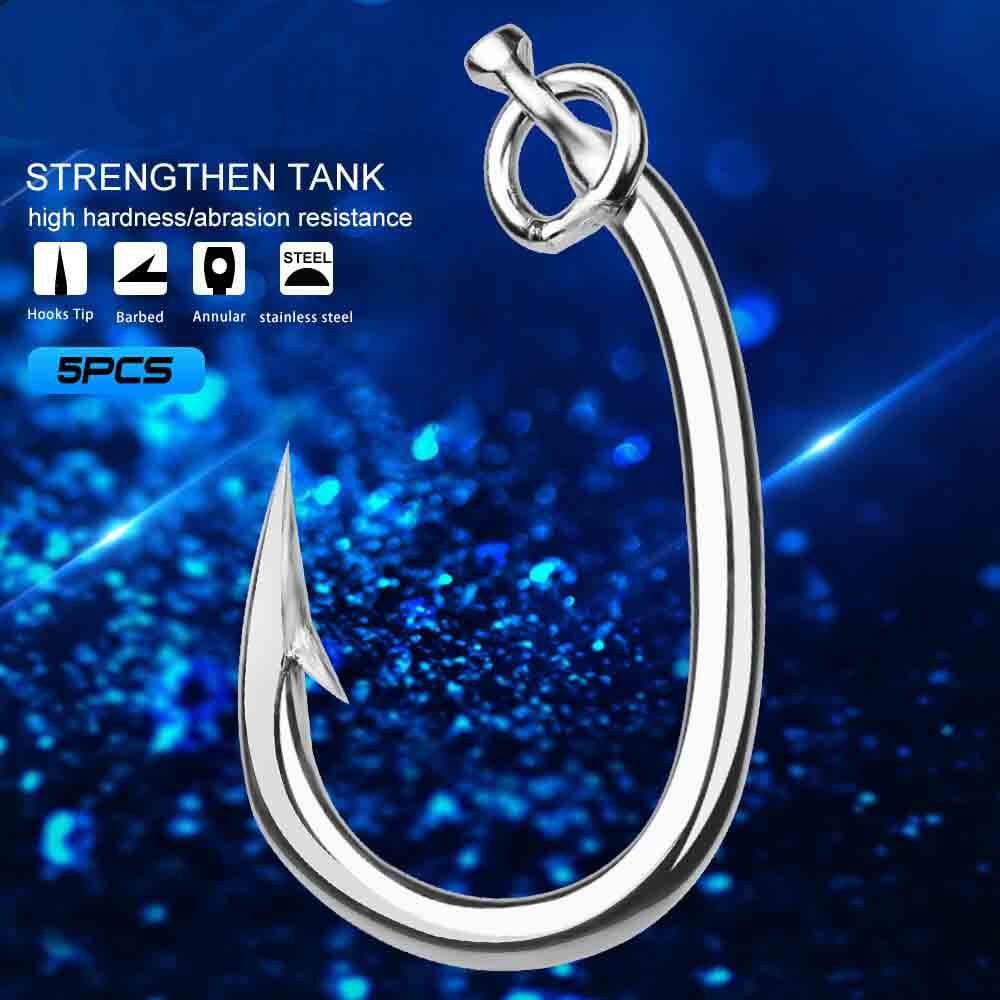
As a sourcing manager, I’ve seen specs lie. “High-carbon steel” is a vast category. For commercial tuna trolling hooks that face immense sudden force, you need a specific grade with the right balance of hardness (for sharpness) and ductility (to bend, not snap). The best tuna hook manufacturer will use forged, high-grade alloys (like C1030 or similar) and be transparent about their tempering process.
Corrosion is the Silent Killer: A hook can be strong but rust out in a season. Look for quality electroplating (tin, nickel) or advanced polymer coatings. For the harshest environments, 316L stainless steel is the gold standard, though it’s more expensive and requires different sharpening techniques.
3. At-Sea Performance: The Data Doesn’t Lie
Theory is good, but sea trials are everything. Let’s look at real-world outcomes.
Case Study: Longline Vessel in the Eastern Pacific
A client’s fleet targeting yellowfin and bigeye tuna conducted a controlled season-long test. On 50,000 hooks deployed:
40%
Повышенный уровень поймки for target species (Yellowfin Tuna) using circle hooks vs. traditional J-hooks on the same gear.
80%
Reduction in Deep-Hooking incidents, leading to healthier released bycatch and compliance with new regional guidelines.
Near 0%
Hooks Pulled Straight with the premium-grade circle hooks, compared to a 3-5% failure rate with their old supplier’s J-hooks.
The financial takeaway? Fewer lost hooks and higher-quality, higher-value fish landed. The switch paid for itself in weeks.
KPI Comparison: What Really Matters on Your Balance Sheet
- Hook-Up Rate: For live bait, circles often win. For high-speed trolling, a sharp, strong J-hook is still king.
- Landing Rate (Hook-Up to Boat): This is where круглые крючки shine. Their secure jaw-hook grip makes it very hard for a fish to throw the hook during the fight.
- Fish Quality: Jaw-hooked fish bleed less internally and are often livelier upon landing, commanding a better price at the dock.
- Crew Safety & Efficiency: Removing a hook from a fish’s jaw is faster and safer than from deep in its gut or gills.
4. The 2026 Procurement Checklist: Vetting Your Tuna Hook Manufacturer
Buying on price per thousand alone is a trap. Here’s how to evaluate a supplier like a pro.
5 Questions to Ask Any Supplier
- “Can you provide a certified material test report for this batch?” (A reputable tuna hook manufacturer will have this).
- “What is your quality control process for heat treatment and tempering?” (This determines strength and brittleness).
- “What specific anti-corrosion coating is applied, and what is its rated salt spray test (SST) hours?” (e.g., 96+ hours to white rust is a good benchmark).
- “Do you offer sample batches for sea trials before a bulk order?” (A confident manufacturer says yes).
- “Can you customize wire diameter, point type, or finish for our specific fishery?” (Flexibility indicates advanced manufacturing capability).
The 7-Point Sample Inspection
When you get samples, don’t just look at them. Test them.
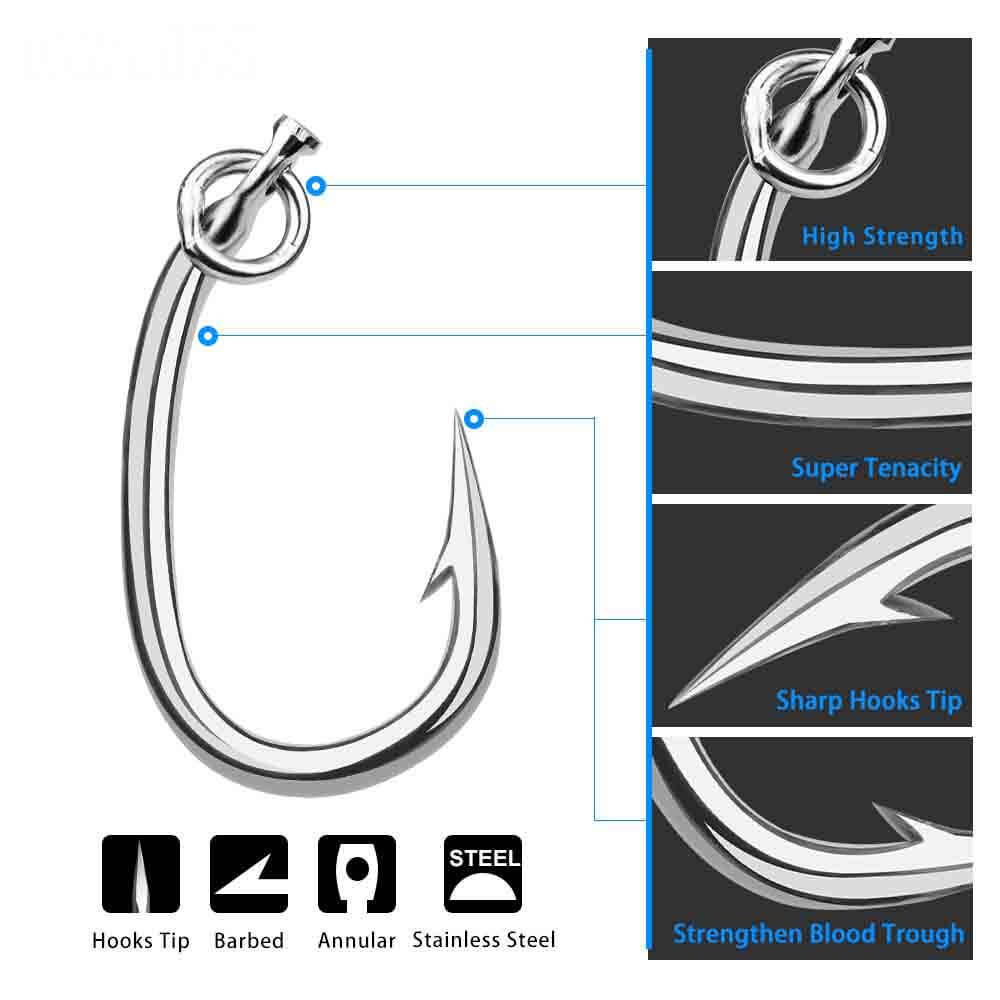
1. Sharpness Test: Does the point lightly catch and dig into your fingernail with minimal pressure? It should.
2. Point Alignment: Look down the shank. Is the point perfectly centered, or is it bent to one side? Misalignment causes poor penetration.
3. Barb Inspection: Is it cleanly formed and adequate to hold, but not so large it creates a massive wound channel?
4. Finish Consistency: Under magnification, is the plating even, with no thin spots, bubbles, or roughness?
5. Eye Closure: For forged eyes, is the seam completely closed and smooth? An open seam cuts leaders.
6. Destructive Pull Test (Sacrifice a sample): Secure the hook in a vise, attach a line, and pull steadily with a scale. Does it bend predictably or snap suddenly?
7. Comparison: Do it side-by-side with your current hook and a known premium brand. The differences become obvious.
5. Costly Myths & How to Avoid Them
Myth 1: “Bigger Gauge = Stronger Hook”
Reality: A thicker wire is more resistant to bending, but it’s also harder to sharpen and provides less penetration. Strength comes from the alloy, forging, and heat treatment. A well-made, thinner hook from a premium tuna hook manufacturer can outperform a cheap, thick one. Focus on the material spec, not just the wire diameter.
Myth 2: “All Hooks from Region X are the Same”
Reality: This is the most dangerous assumption. Manufacturing tolerances, quality control, and material sourcing vary wildly, even within the same industrial area. I’ve seen hooks from the same city have a 40% variance in breaking strength. Audit the factory, not the country.
Myth 3: “Circle Hooks Don’t Work for Tuna”
Reality: They absolutely do, but only in the right application. You wouldn’t use a circle hook on a high-speed cedar plug. But for a live bonito or a chunk bait, they are devastatingly effective for yellowfin, bluefin, and bigeye. The myth persists because people try to “set” them like a J-hook, which pulls the hook right out of the fish’s mouth.
6. Conclusion: Making the Strategic Choice for Your Fleet
The choice between tuna circle hooks и trolling hooks isn’t about which is universally “better.” It’s about matching the tool precisely to the task to maximize your return on investment.
Here’s your simple decision pathway:
- If your primary methods involve live bait, chunking, or deep-dropping where the fish eats the bait, and you value high landing rates, fish quality, and sustainable practices, your default should be a premium circle hook.
- If your primary method is high-speed trolling (8+ knots) with artificial lures for aggressive surface feeders, a well-forged, sharp, and strong traditional tuna trolling hook remains the optimal tool.
- The most successful fleets I work with now carry both, deploying each for its specific tactical advantage. Their tuna hook inventory is a strategic asset, not a commodity.
The goal is to stop thinking in terms of “hooks” and start thinking in terms of “successful connections per dollar spent.” That shift in perspective is what separates profitable, forward-thinking operations from the rest.
Ready to Optimize Your Hook Strategy?
Don’t gamble your season on guesswork. Our team at Havenseek Fishing Tackle specializes in analyzing specific fleet operations and recommending the exact terminal tackle specifications to improve your KPIs. We provide factory-direct sourcing with full material traceability.
Get a free, no-obligation consultation and a sample pack matched to your target species and fishing method. Let’s put the right tool on the end of your line.
Request Your Free Sample & Fleet Assessment NowОбычно отвечает в течение 12 часов.
Часто задаваемые вопросы (FAQ)
Q: I mostly troll. Are circle hooks completely useless for me?
А: For traditional high-speed trolling with lures, yes, a standard J-hook style tuna trolling hook is superior. However, if you do any “slow trolling” with live baits (a deadly technique for tuna), switching those lines to circle hooks can significantly increase your hook-to-land ratio. Don’t write them off entirely; integrate them tactically.
Q: What’s the single biggest mistake people make when first using circle hooks?
A: Setting the hook. It’s a deeply ingrained habit. The crew must be retrained: on a bite, point the rod at the fish, let the line come tight, and start reeling. The hook will set itself in the corner of the jaw. A forceful sweep will pull it right out. This is the most critical technique to master.
Q: How do I know if a hook manufacturer is reputable?
А: Ask for proof, not promises. A reputable tuna hook manufacturer will readily provide: 1) Material Certifications (MTC), 2) Salt Spray Test results for their coatings, 3) samples for your own testing, and 4) often, they will have their own in-house destructive testing equipment. Transparency is the hallmark of quality.
Q: Is a more expensive hook always better?
А: Not always, but there is a strong correlation. The price reflects material cost, quality control steps, and advanced manufacturing (like forging vs. bending). A cheap hook is a false economy. Calculate cost based on “landed fish per dollar” not “hooks per dollar.” A hook that costs 3x more but lands 50% more fish is vastly cheaper in the long run.
Q: What size circle hook is best for 100lb+ tuna?
А: For large bluefin or yellowfin, a 16/0 to 20/0 circle hook is common. However, size is less important than wire diameter and strength. Match the hook’s strength to your leader. A stout 16/0 is often better than a lightly-wire 20/0. Always consult with your supplier for species-specific recommendations, as gap width is as important as the size number.
Q: Can circle hooks be re-sharpened effectively?
А: Absolutely, and they should be. The unique inward-pointing angle requires a specific sharpening technique. Use a round file or a dedicated hook sharpener, working from the inside of the point’s curve outward. Maintaining a needle-sharp point is critical for the hook’s “roll and set” mechanism to work properly.
Ссылки и дополнительная литература
To support the data and perspectives in this guide, here are links to authoritative external sources: