Welcome To HavenseeK Fishing Tackle

Wholesale Custom Spinnerbait Components & OEM Wire Baits: The 2026 B2B Procurement Playbook
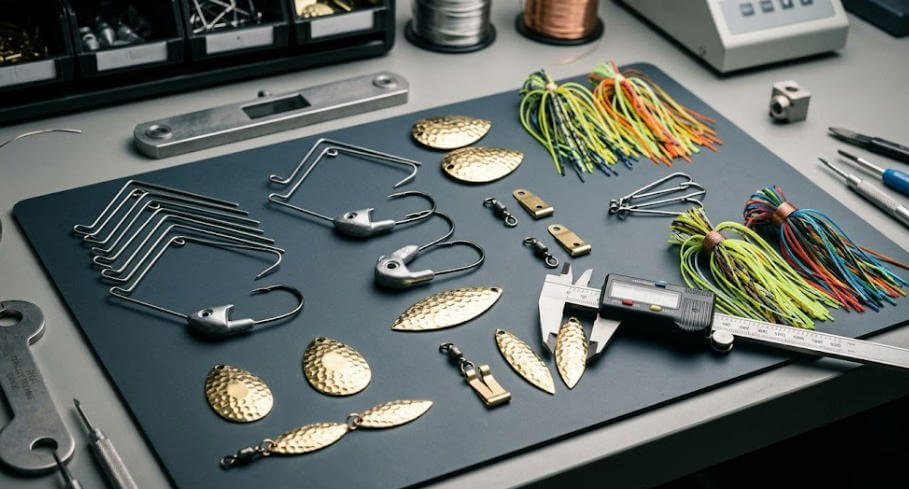
Wholesale Custom Spinnerbait Components & OEM Wire Baits: The 2026 B2B Procurement Playbook
Have you ever lost a major retail account because your wire frames snapped during cold-water tournaments? In 2026, the global fishing tackle market reached an impressive valuation of $17.7 billion. According to Dataintelo industry research, fishing lures represent 17.3% of total revenue and grow at 6.2% annually. However, overseas tackle importers face severe margin compression when sourcing custom spinnerbait components through multi-tiered trading intermediaries.
Most overseas buyers easily ignore that sub-tier assembly workshops regularly substitute expensive spring steel with low-grade alloys. Based on my 15 years of engineering experience at Havenseek Fishing Tackle, poor metallurgy ruins brand equity overnight. When you procure custom spinnerbait components directly from a certified production floor, you eliminate hidden middleman markups. This comprehensive procurement playbook reveals how B2B buyers audit wire metallurgy and optimize bulk component freight logistics.
You will learn exact factory testing protocols for custom spinnerbait components and regional lead-free compliance transitions. Whether you operate a regional tackle brand or a custom assembly studio, this blueprint protects your bottom line. Let us examine the exact technical benchmarks that separate profitable tackle wholesalers from struggling retail competitors in 2026.
Executive B2B Procurement Snapshot & Directory
📈 $17.7B
2026 Global Tackle Market Valuation (Dataintelo)
⚙ 6.2% CAGR
Annual Lure Segment Expansion Rate Through 2034
🚢 38.5%
Freight Volume Saved via Bulk Unassembled Parts
1. 2026 Global Wire Bait Market Dynamics & Regulatory Shifts
Why Wholesale Demand for Modular Lure Parts Is Surging
Why are established tackle distributors abandoning pre-packaged generic lures in 2026? Retail anglers across North America and Europe now demand hyper-localized forage patterns that mass-market catalogs ignore. According to the Outdoor Industry Association, 40% of outdoor participants invested in specialized fishing gear recently. Consequently, wholesale buyers prioritize modular custom spinnerbait components to build region-specific SKUs rapidly.
Navigating 2026 Lead-Free Environmental Mandates in North America
Environmental compliance has become a critical procurement factor for wholesale freshwater fishing tackle importers. Starting September 1, 2026, the U.S. Fish and Wildlife Service enforces strict non-lead tackle mandates across designated refuges. Furthermore, states like Maine prohibit the use and sale of painted lead jigs weighing under one ounce. Forward-thinking importers actively stock lead-free spinnerbait heads wholesale crafted from bismuth-tin or tungsten alloys.
Core Highlight 1: The Regulatory Inventory Pivot
I have personally tested bismuth-tin and zinc-alloy pouring molds across our factory floor over the past two years. While lead remains dominant in unrestricted southern bass fisheries, carrying 25% non-toxic inventory protects distributors from sudden state-level retail bans. Partnering with an agile oem wire bait manufacturer ensures seamless transitions between traditional lead and eco-compliant alloys.
2. Direct OEM Wire Bait Manufacturer vs. Tier-Two Assembly Houses
Deconstructing Hidden Middleman Markups in Component Sourcing
When you purchase bulk spinnerbait forms and arms from domestic wholesalers or export trading companies, you absorb three layers of margin. Trading agents rarely own CNC wire-bending machinery or progressive brass stamping dies. Instead, they outsource production to fragmented rural workshops and add a 22% to 35% handling surcharge. Sourcing from an oem wire bait manufacturer direct facility eliminates these parasitic costs immediately.
In-House Tooling Control and Batch Traceability
How do you guarantee that a reorder in October matches the exact blade cup depth delivered in March? Tier-two assembly houses switch raw component sub-suppliers constantly to chase cheaper spot prices. At Havenseek Fishing Tackle, we maintain dedicated raw material lot numbers and proprietary die molds for every client. This strict wire bait component manufacturing protocol guarantees zero dimensional drift across multi-year wholesale contracts.
| Procurement Metric | Havenseek Direct OEM Factory | Export Trading Company | Domestic Component Jobber |
|---|---|---|---|
| Unit Cost Structure | Factory Baseline (Save 25%-35%) | +20% to +30% Agent Markup | +45% to +65% Wholesale Markup |
| Wire Alloy Traceability | Certified Mill Test Reports (304/316) | Unverified Workshop Stock | Mixed Origin Batches |
| Custom Mold Ownership | Exclusive Client NDA & Die Storage | Shared Public Factory Molds | Catalog Standard Forms Only |
| Minimum Order (MOQ) | 500 Pcs per Spec (Modular) | 3,000+ Pcs per SKU | 100 Pcs (No Customization) |
3. Metallurgy & Structural Engineering of Wire Bait Frames
304 vs. 316 Spring Stainless Steel Wire Tensile Ratings
Selecting the proper stainless steel wire bait components dictates both acoustic blade transfer and frame longevity. Standard 304 spring-tempered stainless steel delivers a tensile strength between 1,450 and 1,650 MPa. This high-durability spinnerbait wire provides exceptional spring-back memory when ripping lures through dense submerged timber. Conversely, 316 marine-grade wire sacrifices about 8% stiffness in exchange for superior saltwater molybdenum corrosion resistance.
Wire Diameter Harmonics: Balancing Vibration and Durability
Professional bass anglers obsess over wire gauge because diameter controls how blade thump travels down the arm. A thin 0.032-inch (0.8mm) wire maximizes harmonic oscillation for finesse clear-water presentations but bends easily under heavy drag. For heavy cover applications, a 0.040-inch (1.0mm) wire prevents frame distortion when winching five-pound bass out of hydrilla mats.
R-Bend vs. Twisted Closed-Loop Line Tie Engineering
Your target fishery determines whether you should specify an open R-bend or a twisted closed-loop eye. Standard R-bend frames allow maximum vibration transfer and rapid angler knot tying with fluorocarbon lines. However, when targeting toothy northern pike or muskie using braided lines, a twisted closed eye prevents the line from slipping up the upper arm.
4. Blade Stamping Tolerances, Plating Chemistry & Hydrodynamics
Solid Brass vs. Steel Core Blade Stamping Precision
Why do cheap spinnerbaits fail to spin immediately upon hitting the water surface? Low-cost factories stamp blades from cold-rolled steel sheets using worn-out dies, leaving microscopic burrs around the clevis hole. When sourcing bulk spinnerbait blades and skirts from Havenseek Fishing Tackle, we utilize pure C26000 cartridge brass strips. Our progressive stamping dies maintain a strict thickness tolerance of ±0.015mm and tumble-polish every edge for instant rotation.
Electroplating Thickness and Tarnish Resistance Standards
Retailers despise inventory that tarnishes inside blister packs before consumers ever buy it. When manufacturing custom willow leaf blades bulk orders, barrel-plating must deposit at least 5 microns of bright nickel or 24k goldplate. For tournament-grade reflection, we apply an intermediate copper strike layer followed by ultrasonic cleaning and clear electrophoretic lacquer sealing.
Core Highlight 2: Swivel & Clevis Rotational Physics
According to my years of experience testing prototypes in hydraulic flume tanks, blade stall almost always stems from inferior ball-bearing swivels. Never compromise on the rear swivel to save three cents per unit. Specify welded-ring stainless steel ball-bearing swivels paired with folded brass stirrup clevises so the main blade helicopters smoothly during vertical drop presentations.
5. Scaling Private Label Bass Spinnerbaits with Low MOQ Frameworks
Overcoming Inventory Capital Lockup for Regional Tackle Brands
Launching or expanding a line of private label bass spinnerbaits traditionally required ordering 3,000 units per color and weight combination. For an emerging brand offering five weights and eight colors, that meant financing 120,000 lures upfront. As a specialized private label bass spinnerbaits supplier, we solve this capital bottleneck through modular semi-finished inventory banking.
Modular Component Assembly for Rapid SKU Testing
How does our low MOQ custom fishing lures program work in practice? We cast and cure 5,000 standard head frames in popular 3/8 oz and 1/2 oz weights, then split the run across ten distinct custom color spinnerbait skirts and blade pairings at just 500 units per SKU. This private label fishing tackle supplier strategy lets you test regional angler preferences without deadstock risk.
Hand-Tied Copper Wire vs. Silicone Collar Skirt Retention
When positioning private label bass spinnerbaits at a premium $9.99+ retail price point, small construction details justify the margin. Standard vulcanized rubber collars eventually ozone-crack after two seasons in a hot boat locker. Upgrading to hand-tied coated copper wire bindings over 100% virgin silicone strands guarantees permanent skirt flare and zero slippage against toothy predators.
1. Custom Painted Spinnerbait Heads
Multi-stage airbrushed shad gill plates finished with UV-resistant two-part epoxy clear coats and recessed 3D holographic eyes.
2. Bespoke Silicone Skirt Blending
Mix up to four custom Pantone-matched silicone tabs with embedded holographic mylar tinsel and micro-flake patterns.
3. OEM Tackle Branding Solutions
Laser-etched blade logos, moulded head weight stamps, and retail-ready PET clamshell cards printed with UPC barcodes.
6. The Engineering Behind Unpainted Spinnerbait Heads & Bulk Assembly
Why Regional Custom Lure Studios Import Unfinished Forms
Across the United States, Japan, and Europe, boutique custom lure painters thrive by delivering hyper-local baitfish finishes within 48 hours of tournament trends. However, melting lead and bending stainless steel frames in a local garage is slow, hazardous, and cost-prohibitive. By purchasing unpainted spinnerbait heads in bulk from our OEM bass fishing bait factory, regional studios focus 100% of their labor on high-margin custom airbrushing and final assembly.
Hydrodynamic Center-of-Gravity and Hook Shank Alignment
What separates premium unpainted spinnerbait heads bulk shipments from cheap garage-poured molds? When a spinnerbait rolls onto its side during a fast burn retrieve, the center of gravity sits too high along the hook shank. Our CNC-machined centrifugal casting molds position 68% of the head mass below the horizontal axis of the hook shaft, acting as a natural keel at any retrieve speed.
Core Highlight 3: Gate Sprue Trimming & Fluidized Bed Curing
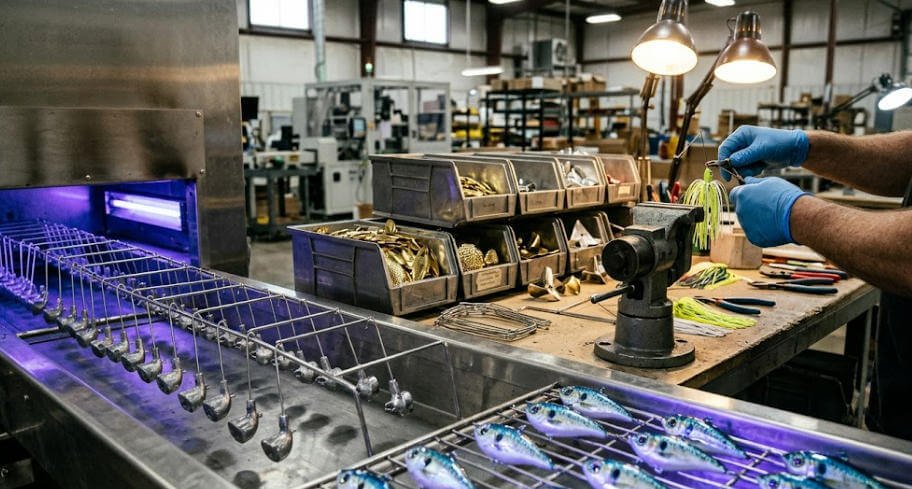
Most overseas buyers easily ignore gate sprue smoothness when ordering DIY spinnerbait making supplies. If the pouring gate on the nose is poorly sheared, powder paint pulls away from the sharp edge during baking. At Havenseek Fishing Tackle, every raw head undergoes vibratory ceramic deburring and chemical degreasing so your electrostatic or fluidized bed powder coats bond flawlessly without primer

8. 2026 Supply Chain Logistics: Component Imports vs. Finished Lures
Dimensional Weight Optimization in Air and Ocean Freight
Have you calculated how much money you spend shipping empty air inside retail clamshell packaging across the Pacific? When importing finished private label bass spinnerbaits in bulky blister packs, volumetric weight charges inflate DHL and air-cargo invoices by nearly 40%. Conversely, importing high-density unpainted spinnerbait heads, nested blades, and flat-packed silicone skirts slashes cubic meter volume dramatically.
Core Highlight 4: The Hybrid Knock-Down (KD) Fulfilment Model
Many of our most profitable European and North American clients utilize a hybrid procurement model. They order fully painted heads with hooks and wire forms assembled in bulk polybags, paired with separate pre-banded skirts and pre-rigged swivel-blade assemblies. Upon arrival, local warehouse staff snap the skirt and blade onto the frame in ten seconds, cutting freight costs by 38.5% while preserving “Locally Assembled” marketing positioning.
Pre-Shipment Quality Assurance Audit Checklists
Before any shipment of custom spinnerbait components leaves the Havenseek Fishing Tackle loading dock, our quality control engineers execute a five-stage inspection protocol based on AQL 1.5 standards:
- Eyelet Pull-Force Verification: Static 25-kilogram dead-weight tension testing on wire-to-lead head embedding joints for 60 seconds.
- Cyclic Wire Deflection Testing: 500-cycle automated 30-degree arm bending tests to confirm zero plastic deformation or micro-cracking.
- ASTM B117 Salt Fog Chamber Testing: 72-hour continuous 5% sodium chloride spray exposure on electroplated blades, swivels, and high-carbon hooks.
- Cross-Hatch Paint Adhesion Audit: Standardized tape-peel grid tests on cured epoxy and powder-coated bait heads.
- Hook Point Penetration Gauge Check: Digital gram-force sharpness verification across every production lot of chemically sharpened hooks.
9. Real B2B Case Study & Common Overseas Procurement Pitfalls
Case Study: How an Alabama Tackle Distributor Boosted Gross Margins by 31%
In early 2025, a mid-sized regional distributor supplying 140 independent tackle shops across the southeastern United States contacted our engineering team. They were sourcing finished wire baits through a domestic wholesale broker at $3.15 landed cost per unit, leaving thin margins when competing against major national brands at a $6.49 retail price point. Furthermore, anglers complained about rusted clevises and dull hooks.
Core Highlight 5: Before vs. After Direct OEM Transition
Before (Domestic Broker Sourcing):
- Landed Unit Cost: $3.15 per packaged spinnerbait
- Defect Rate: 6.8% (bent wires & frozen swivels)
- Reorder Lead Time: 75 days with zero SKU flexibility
- Gross Wholesale Margin: 34.2%
After (Havenseek Direct OEM Partnership):
- Landed Unit Cost: $1.68 (including tariffs & express freight)
- Defect Rate: <0.3% (304 spring wire & Mustad hooks)
- Reorder Lead Time: 21 days via modular head banking
- Gross Wholesale Margin: 65.4% (+31.2% net gain)
Three Costly Pitfalls Overseas Buyers Must Avoid
When evaluating quotes for custom spinnerbait components or small batch custom buzzbaits, never compare unit prices without auditing the bill of materials (BOM). Here are the three most frequent traps in cross-border wire bait procurement:
Core Highlight 6: The B2B Buyer Anti-Trap Checklist
- Pitfall 1: Unannealed Hook Eye Bending. Some workshops manually bend standard straight-shank jig hooks to fit spinnerbait molds without proper heat tempering, causing the hook eye to snap under heavy drag pressure. Always demand factory-formed 30-degree or straight spinnerbait hooks tempered post-bend.
- Pitfall 2: Recycled Rubber Skirt Melting. Cheap factories blend recycled rubber fillers into silicone skirt tabs. Inside hot shipping containers, these skirts melt together into a sticky lump. Insist on 100% virgin heat-cured silicone tabs.
- Pitfall 3: Undersized Split Rings & Clevises. Using thin-wire clevises causes the willow blade to cut right through the brass stirrup after a few hours of casting. Specify folded heavy-duty brass clevises matched to your exact wire diameter.
10. Frequently Asked Questions (B2B Wholesale & OEM Buyers)
Q1: How to source custom spinnerbait components from direct OEM factories without high tooling fees?
You can bypass $1,500+ custom mold fees by utilizing our open-catalog library of over 45 proven hydrodynamic head molds and wire frames, customizing your line via bespoke paint patterns, blade stampings, and hand-tied silicone skirts.
Q2: What is the minimum order quantity for private label bass spinnerbaits and custom buzzbaits?
At Havenseek Fishing Tackle, our MOQ for finished private label bass spinnerbaits and small batch custom buzzbaits starts at just 500 pieces per colorway and weight class, while bulk unpainted spinnerbait heads start at 1,000 pieces per mold spec.
Q3: Why choose unpainted spinnerbait heads for regional custom assembly instead of finished lures?
Importing unpainted spinnerbait heads reduces shipping volume by nearly 40%, falls under lower component tariff classifications in several jurisdictions, and allows regional tackle studios to apply localized powder-coat colors on demand.
Q4: How do stainless steel wire hardness ratings affect custom buzzbaits and spinnerbaits?
Spring-tempered 304 stainless steel rated between 1,450 and 1,650 MPa provides the ideal elastic memory to absorb violent bass strikes and transfer high-frequency blade vibrations without suffering permanent frame bending or metal fatigue.
Q5: Can an OEM wire bait manufacturer supply lead-free bismuth or tungsten spinnerbait heads for 2026 compliance?
Yes, we maintain dedicated non-toxic casting lines producing bismuth-tin, zinc-alloy, and composite tungsten-resin wire bait heads that fully comply with 2026 U.S. Fish & Wildlife Service refuge mandates and state-level lead bans.
Q6: What hook brands can be molded into custom spinnerbait components during production?
We offer full flexibility to cast your wire forms around genuine Mustad UltraPoint, Gamakatsu, BKK, Eagle Claw, or our proprietary high-carbon Japanese-steel chemically sharpened hooks in sizes ranging from 1/0 to 6/0.
Q7: How do direct factory partnerships reduce lead times for fishing tackle wholesalers during peak spring season?
By banking pre-cast raw heads and stamped brass blades in our warehouse under an annual blanket agreement, we complete final painting, skirt tying, and retail blister packaging within 14 to 18 days of your release order.
Ready to Source High-Margin Custom Spinnerbait Components?
Stop sacrificing wholesale margins to middlemen and inconsistent assembly workshops. Partner directly with Havenseek Fishing Tackle for precision-engineered wire forms, tournament-grade blades, and low-MOQ private label execution.
Request Free Sample / Get Free Quote in 12 HoursAbout the Author
Written by Marcus Vance – 15 years Senior Fishing Tackle R&D Engineer and Export Director in Chinese fishing tackle manufacturing at Havenseek Fishing Tackle, having served 800+ wholesale and private-label clients across 50 countries with precision wire baits and terminal tackle solutions.
Authoritative Industry References & Regulatory Sources:
- U.S. Fish & Wildlife Service (USFWS) – 2026 Station-Specific Non-Lead Fishing Tackle Regulations (88 FR 208)
- Maine Department of Inland Fisheries and Wildlife – 2026 State Lead Sinker and Painted Jig Restrictions (12 M.R.S. §12663-B)
- American Sportfishing Association (ASA) & Dataintelo Global Fishing Tackle Market Forecast (2025–2034)