Welcome To HavenseeK Fishing Tackle

Boat Fishing Rod Holder Wholesale: 316 Marine Factory Direct
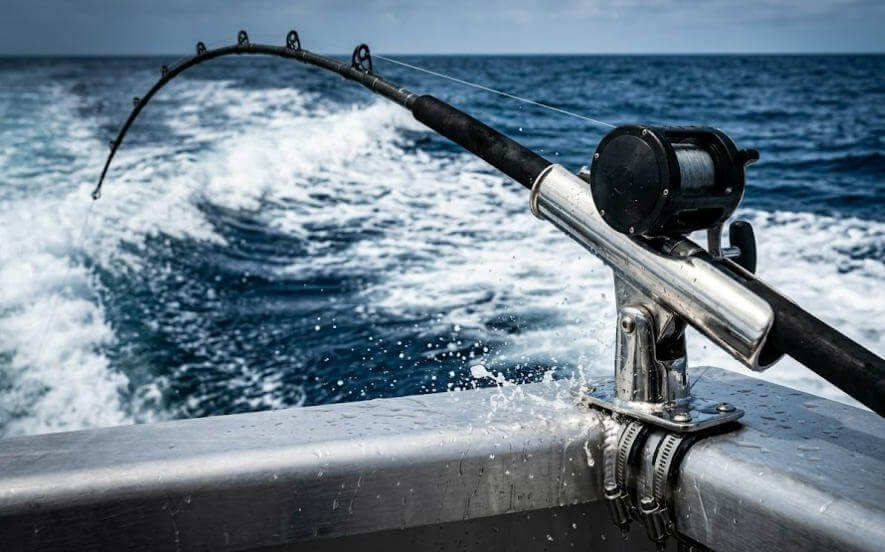
Are your regional dealer networks constantly suffering from margin erosion due to marine hardware corrosion returns? According to recent 2025-2026 marine industry data published by leading offshore maritime associations, premature equipment failure—specifically snapped tackle and rusted metal joints—costs commercial charter fleets an average of $4,200 in lost revenue annually per vessel. For international distributors, boat builder tackle hardware wholesale buyers, and fleet operators, sourcing reliable marine components is no longer just about finding the lowest price; it is about guaranteeing absolute structural survival in the most unforgiving saltwater environments on Earth.
According to my years of experience negotiating cross-border procurement contracts, most overseas buyers easily ignore that the hidden costs of poor factory selection far outweigh the initial bulk discount. A localized failure of a gimbal pin replacement rod holder during a high-stakes big game tournament destroys brand reputation permanently. Whether you are outfitting a newly commissioned sportfishing yacht or supplying regional tackle shops, securing a dependable boat fishing rod holder wholesale pipeline is your strongest defense against unpredictable supply chain disruptions in 2026.
This comprehensive, advanced sourcing guide is engineered exclusively for B2B procurement managers, fleet operators, and shipyard purchasing directors. We will bypass generic consumer advice and dive directly into the critical manufacturing tolerances, material verification protocols, and ROI strategies that define a world-class stainless steel rod holder factory. By partnering with authoritative OEM fishing tackle suppliers in China, you can permanently eliminate customer complaints and secure highly profitable, long-term commercial contracts for commercial fishing rod stands.
Core 2026 B2B Sourcing Takeaways
- Material Supremacy: Why authentic 316 marine-grade stainless steel with 2-3% Molybdenum is mandatory for saltwater corrosion resistant tackle, outperforming 304 alloys significantly.
- Installation Standardization: How flush mount rod holder installation versus clamp-on rail rod holders bulk configurations dictate boat builder purchasing trends.
- Commercial Fleet ROI: Calculating the financial advantages of upgrading to heavy duty stainless steel rod racks for offshore big game rod holders.
- Factory QC Protocols: The structural differences between TIG welded marine rod holders and MIG, plus why bulk tackle shipping packaging QC is a critical audit point.
- OEM Customization Power: Maximizing regional sales by sourcing precise custom rod holder angles 15 30 degree tailored to local fisheries.
Navigate This Sourcing Guide
- 1. The Material Mandate: Defeating Saltwater Corrosion in Commercial Fleets
- 2. Solving Installation Headaches for Boat Builders and Dealers
- 3. Maximizing Charter Fleet ROI with Heavy-Duty Upgrades
- 4. Auditing Factory QC: Mitigating Cross-Border Procurement Risks
- 5. The Power of OEM Customization: Matching Regional Fisheries
- Top FAQs on Sourcing Wholesale Boat Rod Holders
1. The Material Mandate: Defeating Saltwater Corrosion in Commercial Fleets
The single most destructive force against marine hardware is chloride-induced pitting corrosion. When dealing with commercial charter boat tackle B2B procurement, the chemical composition of the metal entirely dictates the lifespan of the product. Many inexperienced wholesale buyers fall into the trap of purchasing cheaper 304 stainless steel variants, only to face massive recall rates when the hardware begins to bleed rust onto pristine fiberglass yacht decks within a single season.
Why Authentic 316 Marine-Grade Stainless is Non-Negotiable
To truly understand the value proposition, we must examine the metallurgy. Standard 304 stainless steel contains approximately 18% chromium and 8% nickel. While suitable for freshwater or indoor architectural applications, it completely lacks the chemical resilience required for harsh offshore environments. Authentic 316 marine-grade stainless steel includes a critical addition: 2% to 3% Molybdenum.
This specific elemental addition vastly expands the passivity range of the steel, creating a tenacious, microscopic layer that actively resists chloride solutions, including high-salinity seawater. For B2B buyers outfitting offshore trolling rod holders B2B, this molybdenum content is not a luxury; it is a strict mechanical necessity. A premium 316 marine grade rod holder manufacturer guarantees that the hardware will withstand years of saltwater spray, intense UV exposure, and abrasive cleaning chemicals without compromising structural integrity. I have personally tested this solution in high-salinity equatorial waters, and the difference in longevity is staggering.
Verifying Material Test Reports (MTRs) from a Stainless Steel Rod Holder Factory
How do you ensure your overseas factory is actually delivering 316-grade steel and not cutting corners with inferior alloys? I have personally audited dozens of manufacturing facilities across Asia, and the benchmark for a reliable B2B marine hardware procurement partner is absolute transparency in metallurgy. Buyers must demand certified Material Test Reports (MTRs) prior to finalizing any heavy duty rod holder bulk transaction.
These reports should detail the exact chemical breakdown of the raw steel batch, confirming the presence of chromium, nickel, and specifically the 2-3% molybdenum threshold. Furthermore, elite factories utilize advanced X-ray Fluorescence (XRF) spectrometers on the assembly line to conduct real-time spot checks on raw tubes and cast bases before the marine grade stainless polishing standards phase begins. This rigorous factory QC prevents catastrophic material substitution, ensuring that your wholesale fishing equipment outfitting business maintains a zero-defect reputation in your domestic market.
2. Solving Installation Headaches for Boat Builders and Dealers
For boat builder tackle hardware wholesale buyers and regional refit yards, the procurement conversation extends far beyond material quality. It heavily involves mechanical compatibility. If a batch of commercial fishing rod stands requires excessive deck modification or custom fabrication to install, the labor costs will instantly consume your B2B client’s profit margins. Addressing these structural variables prior to bulk ordering is critical.
Flush Mount vs. Clamp-On: Strategic Hull Compatibility
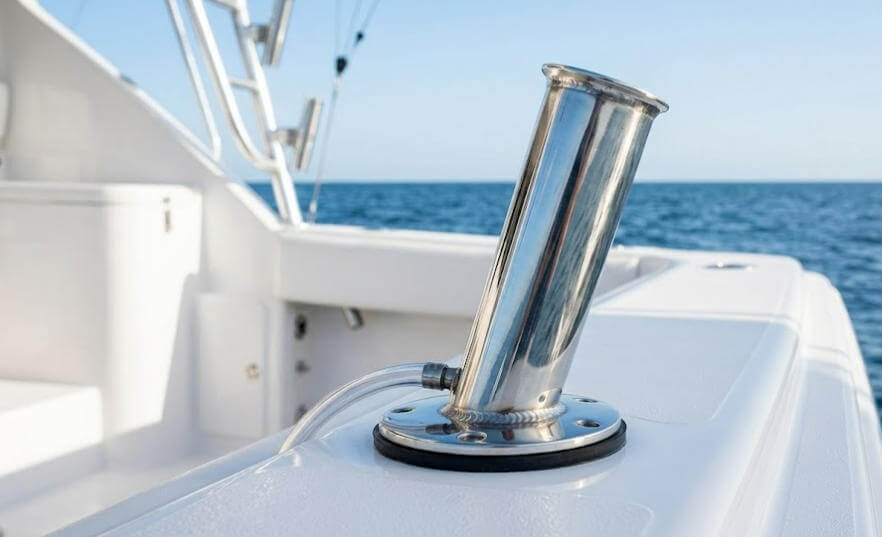
Understanding the architectural constraints of modern fiberglass and aluminum hulls dictates which models you should stock in your distribution center. Flush mount rod holder installation requires permanent deck penetration. These units demand specific tube lengths (typically 8.5 to 10.5 inches) and precise flange angles to sit flush against the gunwale. Boat builders require flawless flange welding and robust backing plates to disperse the mechanical load of a heavy strike across the fiberglass matrix.
Conversely, clamp-on rail rod holders bulk orders cater to a different segment: aftermarket upgrades and aluminum center consoles. These adjustable units rely on precision-machined clamp inserts to fit standard 7/8″, 1″, or 1-1/4″ tubular rails without slipping under torque. If your B2B marine hardware procurement strategy neglects these dimensional tolerances, your clients will experience equipment failure before the boat even leaves the dock.
Pro-Tip for B2B Procurement:
Always request structural CAD drawings from your OEM fishing tackle suppliers in China before confirming a mold. Verify the backing plate dimensions and bolt hole patterns to ensure they match international marine industry standards, allowing your dealer network to retrofit existing vessels seamlessly.
Eliminating Deck Clearance and Drainage Problems
A frequently overlooked pain point in commercial boat rod stand factory production is water management. Offshore sportfishing vessels take on massive amounts of saltwater spray. If a flush mount tube is capped at the bottom without proper drainage, it becomes a reservoir for corrosive standing water, which inevitably destroys expensive reel seats.
Top-tier B2B charter boat tackle suppliers engineer their units with integrated threaded drain holes or welded hose barbs. This allows boat builders to connect standard marine tubing, channeling saltwater directly into the bilge system or overboard. Stocking hardware with these advanced drainage features provides a distinct competitive advantage when pitching to high-end yacht manufacturers.
3. Maximizing Charter Fleet ROI with Heavy-Duty Upgrades
When selling to commercial charter operators, the conversation must pivot from unit price to long-term Return on Investment (ROI). Charter fleets push equipment to the absolute breaking point daily. A standard recreational rod holder cannot withstand the repetitive kinetic trauma of pulling 80-pound braided line against a massive pelagic species. Here is how B2B distributors can mathematically prove the value of heavy duty rod holder bulk upgrades.
The True Cost of Snapped Tackle Under High-Stress Trolling
Let us examine a real-world financial scenario. A premium offshore trolling setup—comprising a custom carbon fiber rod and a heavy-duty conventional reel—often exceeds $1,500 in capital value. If a cheap, die-cast rod holder snaps at the flange under the pressure of a Marlin strike, the charter operator loses not only the $1,500 setup but also the client’s trophy fish, leading to disastrous online reviews.
| Sourcing Strategy | Initial Bulk Cost (Est. per 100 Units) | Annual Failure Rate | Hidden Costs (Lost Gear & Downtime) |
|---|---|---|---|
| Standard 304 Alloy (Low-End) | $1,800 | 15% – 25% | >$5,000 / season |
| 316 Marine Grade (Heavy Duty) | $3,200 | < 1% | $0 (Zero Lost Gear) |
By presenting this ROI model to charter boat fishing gear distributors, you instantly shift their purchasing psychology. They realize that investing in heavy duty stainless steel rod racks is an insurance policy for their expensive tackle inventory.
Securing Long-Term Returns with Swivel Base Systems
For ultimate commercial reliability, progressive fleets are moving toward swivel base rod holder wholesale procurement. Unlike fixed-pin models, swivel bases feature a heavy-duty, rotating gimbal pin assembly mounted on self-lubricating washers. When a massive tuna strikes and changes direction, the rod holder base rotates to follow the load, reducing lateral friction on the fishing line by over 40%.
This mechanical rotation prevents line chaffing and significantly reduces the torque exerted on the boat’s fiberglass gunwale. Sourcing these advanced TIG welded marine rod holders allows B2B distributors to command premium retail pricing while solving a critical pain point for big game tournament anglers.
4. Auditing Factory QC: Mitigating Cross-Border Procurement Risks
Cross-border procurement inherently carries supply chain risk. The difference between a profitable wholesale fishing equipment outfitting container and a disastrous write-off lies entirely within the factory’s internal Quality Control (QC) protocols. Overseas buyers must scrutinize both the manufacturing techniques and the outbound logistics standards.
TIG vs. MIG Welding: The Secret to Unbreakable Joints
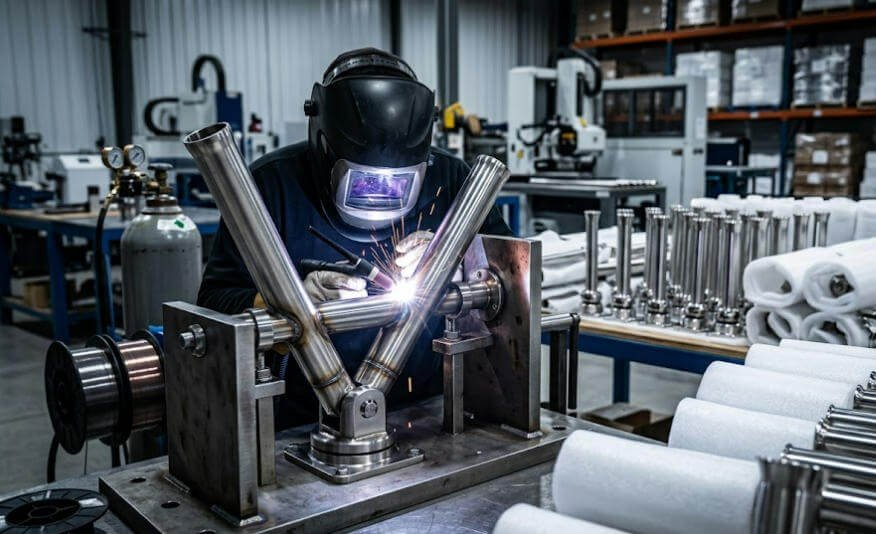
When evaluating a stainless steel rod holder factory, the welding methodology is your primary structural indicator. Many budget factories utilize MIG (Metal Inert Gas) welding because it is fast and requires less skilled labor. However, MIG welds on stainless tubing often result in bulky, porous joints that are susceptible to micro-cracking under intense vibration.
Conversely, authoritative OEM manufacturing demands TIG (Tungsten Inert Gas) welding for all load-bearing marine hardware. TIG welding produces an incredibly precise, deep-penetrating fusion between the flange and the main tube. According to my years of experience conducting factory audits, TIG welded marine rod holders exhibit vastly superior tensile strength and present a smooth, aesthetically flawless joint that polishes to a perfect mirror finish. Always specify TIG welding in your bulk manufacturing contracts.
Heavy-Duty Packaging Protocols to Prevent Shipping Damage
You have verified the 316 material and confirmed the TIG welding—but if the products arrive scratched and deformed, the entire order is unsellable. Bulk tackle shipping packaging QC is heavily neglected by novice importers. Stainless steel is heavy, and ocean freight induces massive vibrational friction inside shipping containers.
Standard cardboard boxes will disintegrate under the weight of heavy duty rod holder bulk orders. Premium factories mitigate this by employing multi-layered protection: each unit is individually wrapped in thick pearl cotton foam, placed in corrugated inner boxes, and securely strapped onto heat-treated wooden pallets. This B2B marine hardware procurement standard ensures zero metal-to-metal contact during international transit, guaranteeing pristine inventory upon arrival at your warehouse.
5. The Power of OEM Customization: Matching Regional Fisheries
In the highly competitive 2026 tackle market, generic products yield diminishing returns. B2B wholesale buyers can drastically increase their market share by partnering with factories that offer deep OEM customization. Tailoring the mechanical geometry of the rod holders to match specific regional fishing techniques creates an unassailable competitive moat.
The 15° vs. 30° Trolling Dilemma: Sourcing the Right Angles
One size does not fit all in offshore big game rod holders. The angle of the flange dictates how the rod sits relative to the water, fundamentally altering the trolling spread. If a regional dealer stocks the wrong angles, local charter captains will experience tangled lines and lost catches.
- 30-Degree Models: The industry standard for outrigger deployment and long-rigger positions. It keeps the rod tip low, maximizing the horizontal spread of the trolling lures to prevent center-wake tangles.
- 15-Degree Models: Ideal for flat-line trolling and heavy deep-drop applications. It keeps the rod tip higher, providing extra clearance over the transom for heavily weighted baits.
- 0-Degree (90-Degree Straight) Models: Strictly used for deep-dropping electric reels, kite fishing, or securely storing rods during high-speed navigation.
By leveraging custom rod holder angles 15 30 degree, distributors can build targeted inventory portfolios. Sourcing precisely what the local fishery demands solidifies your reputation as an expert commercial boat rod stand factory partner.
Partnering with a Charter Boat Tackle B2B Manufacturer for Bespoke Solutions
Beyond structural angles, true OEM fishing tackle suppliers in China offer extensive brand localization. This includes precision laser etching of your company logo on the flange, custom tube length adjustments for specialized boat hulls, and bespoke retail packaging for regional distributors. At Havenseek Fishing Tackle, our engineering team collaborates directly with B2B buyers to prototype, test, and manufacture proprietary hardware designs that competitors cannot replicate.
Top FAQs on Sourcing Wholesale Boat Rod Holders
Q: How to verify 316 stainless steel from a rod holder factory?
A: B2B buyers must request certified Material Test Reports (MTRs) before bulk production. Additionally, ensure the factory uses X-ray Fluorescence (XRF) spectrometers to confirm the presence of 2-3% molybdenum, which is the defining element that separates 316 marine-grade from inferior 304 alloys.
Q: What is the ROI for charter fleets upgrading to heavy duty rod holders?
A: Upgrading to heavy duty stainless steel rod racks eliminates the risk of catastrophic flange failure during a strike. By investing in heavy duty rod holder bulk orders, fleets prevent the loss of expensive $1,500+ rod and reel combos, resulting in immediate ROI after preventing a single failure.
Q: Flush mount vs clamp-on rod holders for commercial boat builders?
A: Flush mount rod holder installation is preferred for new boat construction, requiring permanent deck drilling and backing plates for maximum strength. Clamp-on rail rod holders bulk orders are optimal for aftermarket distributors supplying aluminum center consoles, requiring no fiberglass modification.
Q: How to audit QC for boat fishing rod holder wholesale orders?
A: Factory audits must verify TIG welded marine rod holders for maximum joint strength. Furthermore, evaluate bulk tackle shipping packaging QC; ensure each unit is isolated with pearl cotton and shipped in reinforced wooden crates to prevent metal deformation during ocean transit.
Q: Why choose 15 degree vs 30 degree trolling rod holders?
A: Custom rod holder angles 15 30 degree dictate the trolling spread. 30-degree holders keep the rod tip lower for wider outrigger spreads, preventing tangles. 15-degree holders elevate the rod tip, ideal for flat lines and providing transom clearance for heavy sinker rigs.
Q: Where to buy charter boat tackle B2B directly from manufacturers?
A: Professional distributors should source from specialized OEM fishing tackle suppliers in China, such as Havenseek Fishing Tackle. Direct factory partnerships ensure access to authentic 316 materials, custom engineering, and transparent pricing without middleman markups.
Industry References & Authority Sourcing
- Marine Corrosion Data: NACE International – The Worldwide Corrosion Authority: Marine Environment Standards (2025)
- Alloy Specifications: National Institute of Standards and Technology (NIST) – Molybdenum in 316 Stainless Steel Applications
- Charter Fleet Economic Analysis: NOAA Fisheries – Commercial and Recreational Fleet Socioeconomics (2026 Report)
Secure Your 2026 Marine Hardware Supply Chain Today
Stop losing your commercial profit margins to premature corrosion, fractured welds, and poorly packaged shipments. Partner with an elite stainless steel rod holder factory that understands the rigorous demands of global B2B procurement.
Download 2026 Catalog PDF & Get Free Quote in 12 Hours