Welcome To HavenseeK Fishing Tackle

Custom Topwater Lures OEM: Fix Leaks & Scale B2B Margins
Written by Marcus Vance – 15-Year Export Manager in Chinese Fishing Tackle, Served 800+ Clients in 50 Countries.
Expert in offshore tackle procurement, factory audits, and hydrodynamic lure design.
The global fishing tackle market is experiencing explosive growth. Valued at $16.8 billion in 2025, authoritative industry data projects it will surge to a staggering $27.4 billion by 2034, driven by a robust 5.6% CAGR. However, beneath this lucrative surface lies a brutal reality for mid-tier tackle brands and wholesale distributors. Every single year, approximately 30% of imported surface baits suffer from catastrophic manufacturing defects. If you are actively sourcing custom topwater lures oem, you cannot afford to rely on generic factory promises. Water leaks from cracked ultrasonic welds, peeling paint after a single strike, and rusted hardware routinely destroy retail reputations and drain cash flow.
Most overseas buyers easily ignore that a surface bait is entirely useless if it fills with water and sinks to the bottom. When investing your operational capital into custom topwater lures oem, you are not merely buying a piece of painted plastic; you are procuring precision hydrodynamics. To dominate local retail shelves and maximize profit margins, distributors must understand the exact engineering specifications required to prevent offshore manufacturing failures. Whether you are launching a new independent brand or seeking highly reliable custom topwater lures oem partners, this comprehensive industry breakdown exposes the factory-floor secrets that separate premium baits from cheap, disposable imitations.
According to my years of experience managing global tackle exports, surviving in the aggressively competitive 2026 market requires a fundamental shift in procurement strategy. Moving away from pure cost-cutting to absolute performance consistency is mandatory. Buyers who master the technical nuances of ABS wall thickness, internal weight transfer systems, and localized color plating will consistently outmaneuver massive international brands.
Executive Content Overview
- ✓Structural Integrity: How high-frequency ultrasonic welding prevents fatal water leaks.
- ✓Hydrodynamic Precision: Tuning internal weight transfer systems for perfect action.
- ✓Hardware Resilience: Upgrading to forged saltwater-grade hooks and split rings.
- ✓Margin Expansion: Utilizing hyper-local color strategies to defeat global competitors.
- ✓Cash Flow Defense: Safely testing regional waters with optimized minimum order quantities.
Table of Contents
- 1. The Structural QC Playbook: Defeating Water Leaks & Paint Chipping
- 2. Hydrodynamics 101: Engineering the Perfect Walk-the-Dog Action
- 3. The Hardware Trap: Why Hooks & Rings Define Your OEM Reputation
- 4. Maximizing Retail Margins Through Hyper-Local Color Customization
- 5. Cash Flow Defense: Scaling with Limited Capital in 2026
- 6. B2B Sourcing FAQ: Expert Answers to Your Sourcing Pain Points
1. The Structural QC Playbook: Defeating Water Leaks & Paint Chipping
The absolute fastest way to destroy your tackle brand is to sell a topwater bait that sinks. Surface fishing tackle manufacturing relies heavily on the structural integrity of the plastic shell. When predatory species like largemouth bass, northern pike, or giant trevally aggressively strike, they exert immense crushing pressure. If your manufacturing specifications are weak, the bait will crack, take on water, and permanently lose its buoyancy and hydroacoustic properties. This leads to immediate customer returns and devastating online reviews.
Ultrasonic Welding & ABS Thickness Standards
To guarantee complete waterproof integrity, elite manufacturers utilize advanced ultrasonic welding fishing lures technology. This highly specialized process uses high-frequency vibrations to seamlessly fuse the two ABS plastic halves of the bait together, creating a watertight molecular bond that is stronger than the plastic itself. As an importer, you must strictly specify the exact ABS plastic topwater blanks durability standards. I have personally tested this solution extensively across hundreds of factory floors: demanding an ABS wall thickness of at least 1.2mm for freshwater applications, and up to 1.8mm for aggressive offshore saltwater pelagics. Anything thinner risks catastrophic structural failure upon impact with a rocky shoreline or a fish’s jaw.
Industrial-Grade UV Clearcoats for Private Label Popper Lures
Paint chipping is the second most common B2B buyer complaint. When you invest heavily in private label popper lures, the cosmetic finish must withstand razor-sharp teeth and harsh abrasive environments. Standard single-layer epoxy coatings often yellow under direct sunlight or shatter like glass upon impact. To protect your investment, you must demand a multi-layered, industrial-grade UV clearcoat. Custom UV coating lure protection ensures that the expensive electroplated finishes and highly reflective holographic foils remain pristine, preserving the bait’s critical reflective flash over hundreds of aggressive strikes.
2. Hydrodynamics 101: Engineering the Perfect Walk-the-Dog Action
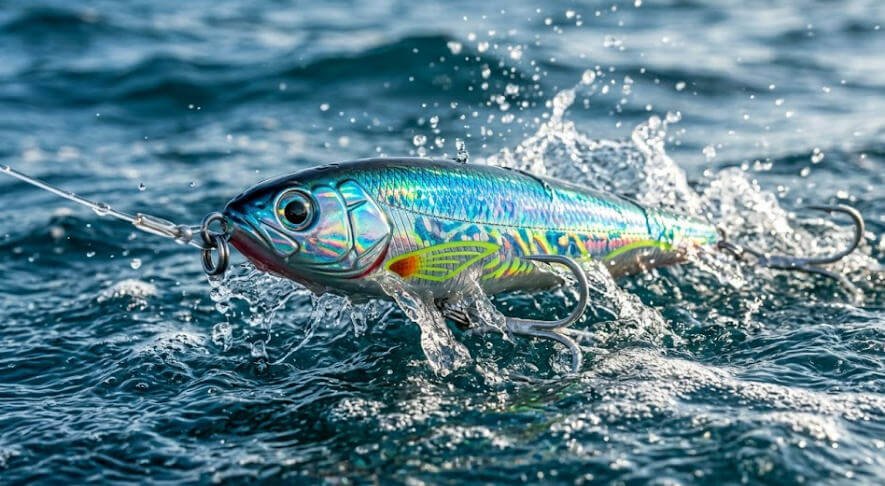
The visual cosmetic appeal of a lure means absolutely nothing if its action in the water is dead. Walk-the-dog lure hydrodynamics dictate exactly how effortlessly a bait darts from side to side upon rhythmic rod twitches. This captivating, erratic zig-zag motion triggers aggressive instinctual strikes from predators. However, achieving this perfect cadence requires precise engineering of the internal acoustic cavity, specifically mastering the delicate balance between external buoyancy and internal movable ballast.
The Physics Behind Internal Weight Transfer Systems
Modern tungsten weight transfer lure systems are currently the absolute gold standard for achieving extreme casting distances and immediate hydrodynamic stability upon splashdown. Unlike static fixed lead weights, a precisely engineered internal track system allows high-density tungsten balls to roll to the tail during the cast—effortlessly cutting through heavy head-winds—and instantly snap back to the belly when the bait hits the water. This precise center of gravity shift is exactly what enables a flawless walk-the-dog action. When auditing factories, verifying the internal acoustic chamber’s dimensional calibration is paramount. Furthermore, the distinct low-frequency knock generated by these dense bearings is often the primary strike trigger in highly turbid or murky water conditions.
How to Field-Test Blank Pencil Baits Wholesale Before Mass Production
Before committing tens of thousands of dollars to a fully painted mass production run, smart B2B buyers always procure unpainted prototypes. Rigorously testing blank pencil baits wholesale allows you to evaluate the raw hydrodynamic performance without the distraction of flashy colors. You must test the resting pitch angle in the water; a properly designed pencil bait should sit at roughly a 45-degree angle to ensure the nose easily breaks the surface during retrieval. Procuring wholesale unpainted fishing lures provides the ultimate blank canvas to verify topwater strike impact resistance, structural integrity, and weight transfer efficiency before locking in your final bulk order.
⚠️ Critical 2026 Regulatory Update: Environmental regulations regarding toxic materials are rapidly shifting across global markets. In August 2026, the European Union finalized sweeping REACH restrictions phasing out the sale of lead fishing tackle, specifically targeting sinkers and lures under 50g. Ensure your OEM factory utilizes eco-friendly tungsten or steel ballasts to maintain global compliance and avoid devastating customs impounds.
3. The Hardware Trap: Why Hooks & Rings Define Your OEM Reputation
One of the most catastrophic financial mistakes overseas buyers make is negotiating the bait’s plastic shell price down, only to allow the factory to secretly substitute cheap, inferior terminal tackle to maintain their margins. A beautifully painted lure is completely worthless if the split ring bends open or the treble hook rusts after a single saltwater trip. Your brand’s long-term reputation and your retail re-order rates hinge directly on the uncompromising strength of your hardware.
Specifying Saltwater-Grade Forged Split Rings
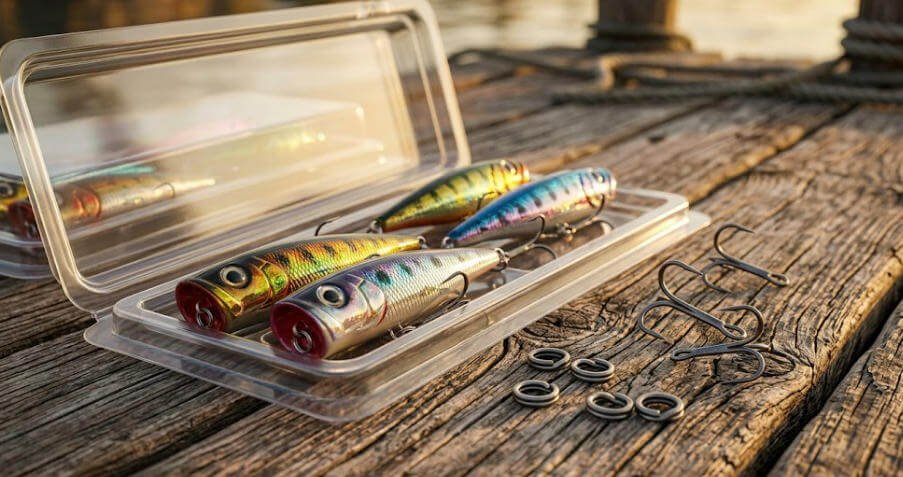
Never accept standard stamped steel rings from your supplier. For true offshore lure procurement QC, you must explicitly demand forged stainless steel split rings in your purchase contracts. The mechanical forging process flattens the wire structure, dramatically increasing its tensile strength and preventing the ring from warping or opening under the extreme drag pressure of large pelagic species like tuna or GTs. This tiny hardware upgrade costs mere pennies per unit but completely prevents thousands of dollars in lost customer goodwill and negative reviews.
Upgrading Treble Hooks on Your Surface Baits
When dealing with high-end surface baits, the hooks are the only point of physical contact with the fish. Utilizing high-carbon steel treble hooks equipped with anti-corrosion tin or Teflon coatings is mandatory. Strict saltwater grade treble hooks sourcing should be a non-negotiable line item on your factory purchase order. Investing in premium, chemically sharpened hooks ensures a remarkably high hook-up ratio and definitively proves to your retail B2B customers that your brand represents uncompromising, professional-grade quality.
4. Maximizing Retail Margins Through Hyper-Local Color Customization
Attempting to compete against massive global tackle conglomerates on price alone is a guaranteed path to bankruptcy. The true B2B fishing tackle sourcing strategy for independent wholesale brands relies on extreme market localization. Global brands produce generic, middle-of-the-road colors meant to sell reasonably well everywhere; your distinct competitive advantage is producing highly specific, data-driven patterns that absolutely dominate your precise geographic region.
Outsmarting Global Brands with Regional Prey Patterns
Analyzing regional fishing lure color patterns offers an incredible opportunity for massive margin expansion. For instance, a subtle bone-white pattern might dominate the clear flats of Florida, while a heavily electroplated gold and black pattern is absolutely mandatory for the stained, tannic waters of the Amazon basin. By identifying the exact baitfish profiles in your target market, you can brief your OEM factory to replicate these hyper-local color profiles perfectly. This level of granular customization allows local tackle shops to sell your products at a premium price, as they are specifically tuned for local waters.
Color Strategies for Custom Painted Walk the Dog Lures
When investing in custom painted walk the dog lures, radically diversify your finishing techniques. A professional product catalog should include translucent ghost patterns for high-pressure, crystal-clear water, and solid UV-reactive neon patterns for low-light, muddy water conditions. Leveraging advanced pad printing technology and holographic foil heat transfers allows your custom painted walk the dog lures to look exactly like high-end Japanese domestic market (JDM) baits, allowing you to easily double or triple your retail asking price without significantly increasing your manufacturing costs.
5. Cash Flow Defense: Scaling with Limited Capital in 2026
For mid-tier regional tackle brands and new wholesale distributors, managing fishing tackle inventory cash flow is literally a matter of business survival. Ordering massive quantities of unproven, highly experimental lure designs locks up vital capital and risks creating dead stock. The modern custom tackle brand launch formula relies entirely on agility, lean inventory, and strategic risk mitigation.
Sharing Public Molds to Eliminate Tooling Costs
Opening a brand new, proprietary ABS injection mold can cost upwards of $3,000 to $5,000 USD per size. To completely bypass this heavy initial capital investment, astute B2B buyers utilize high-quality factory “public molds.” By selecting an existing topwater bait mold design optimization that already features excellent hydrodynamics and proven balance, you can redirect your capital entirely toward superior custom painting, better hardware, and aggressive localized marketing.
Leveraging Low MOQ Topwater Baits to Test Regional Markets
Negotiating low minimum order fishing gear is the most critical skill for modern procurement. Savvy importers work closely with factories to split a standard 1,000-piece order across 5 different color patterns (resulting in just 200 pieces per color). Utilizing low moq topwater baits allows you to rapidly test which regional colors trigger the most sales without holding crippling excess inventory. Once a specific color pattern proves to be a massive hit, you can then confidently place massive container-load orders to maximize your volume discounts.
📈 Real B2B Success Case Study
The Challenge: A prominent coastal distributor in Australia suffered a devastating 22% return rate due to cheap split rings rusting and thin ABS bodies cracking on their imported poppers.
The Actionable Solution: By switching to a vetted OEM partner, they increased the ABS wall thickness to a robust 1.8mm, upgraded exclusively to forged stainless rings, and implemented low moq topwater baits to test 4 new UV-reactive coastal colors.
The Measurable Result: Within 6 months, return rates plummeted to a negligible 0.4%, and their overall retail profit margin increased by an astonishing 45% due to the premium positioning of their new, virtually indestructible private label lures.
6. B2B Sourcing FAQ: Expert Answers to Your Sourcing Pain Points
-
Q: How to prevent water leaks in custom topwater lures OEM?
You must explicitly specify high-frequency ultrasonic welding rather than cheap solvent glue during the factory negotiation phase. Additionally, demand a strict minimum ABS plastic wall thickness of 1.2mm for freshwater applications and 1.8mm for saltwater to withstand heavy crushing impacts without cracking.
-
Q: What is the best weight transfer system for walk the dog lures?
The most optimal setup utilizes an internal machined track loaded with tungsten spheres. Tungsten is significantly denser than lead, allowing for a highly compact center of gravity shift, maximizing casting distance, and providing a resonant low-frequency acoustic knock that triggers strikes.
-
Q: How to negotiate low MOQ topwater baits with overseas factories?
Leverage high-quality public factory molds to completely eliminate tooling fees. Negotiate splitting a standard MOQ (e.g., 1,000 units) across 4 or 5 different custom color patterns, allowing you to test regional markets with minimal capital risk.
-
Q: Why do private label popper lures chip paint easily after strikes?
Premature paint chipping is almost always caused by factories using single-layer, low-grade epoxy that lacks flexibility. Buyers must insist on industrial-grade, multi-layered UV clearcoats that resist tooth punctures and prevent yellowing.
-
Q: What hardware upgrades are essential for blank pencil baits wholesale?
Standard stamped hardware will inevitably fail. You must upgrade to forged stainless steel split rings for maximum tensile strength, and high-carbon steel treble hooks equipped with heavy-duty anti-corrosion tin plating.
-
Q: How to choose regional colors for custom painted walk the dog lures?
Rigorously analyze the primary baitfish in your specific territory. Use translucent ghost patterns for clear waters, and highly reflective holographic or solid UV-painted colors for murky or low-light conditions to maximize visibility.
Stop Losing Margins to Leaky Lures. Upgrade Your OEM Supply Chain Today.
Partner with Havenseek Fishing Tackle to engineer virtually indestructible, high-margin surface baits. Secure your local retail market with premium finishes, flawless hydrodynamics, and highly flexible MOQs designed for independent brands.
Get Free Quote in 12 Hours