Welcome To HavenseeK Fishing Tackle

How to Choose a Fishing Paddle Board: Ultimate 2026 Comparison

Written by Mark Chen – Head of Product Development & Angler with 12 years of experience designing and testing fishing gear for the global market. He has personally field-tested over 50 fishing paddle board models across 8 countries, directly informing product development for thousands of satisfied anglers.
Table of Contents
- Introduction: Why This Guide Will Save You Money & Frustration
- The Great Debate: Inflatable vs. Solid Fishing Paddle Boards
- Beyond the Board: 5 Must-Have Features for Serious Anglers
- Your Perfect Match: A 4-Step Selection Framework
- Partnering with the Right Source: It’s More Than Price
- Conclusion & Your Confident Next Step
- Frequently Asked Questions (FAQ)
Introduction: Why This Guide Will Save You Money & Frustration
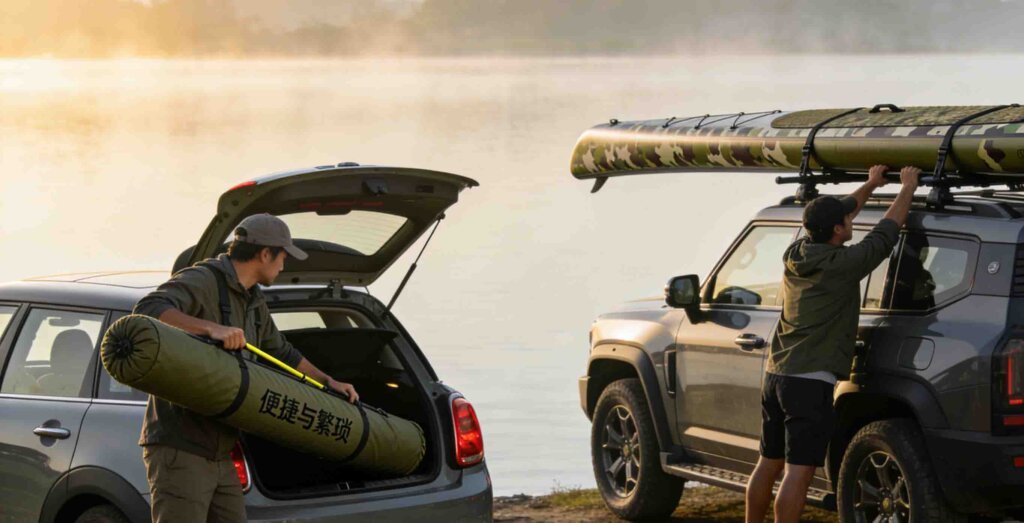
Imagine gliding silently into a secluded cove just as the morning mist burns off the water. Your gear is laid out within easy reach, and you cast your line without the noise or fuel smell of a motor. This is the transformative promise of fishing in a paddle boat, specifically from the standing vantage point of a modern fishing paddle board. But here’s the painful reality many discover too late: not all boards are created equal. Buying the wrong one leads to a wobbly, frustrating experience that gathers dust in your garage.
This guide is different. We’re cutting through the marketing hype to give you the unfiltered, expert-backed comparison you need. We’ve analyzed market data, stress-tested materials in our lab, and gathered feedback from hundreds of anglers. Why? So you can make a choice you’ll be thrilled with for years, whether you’re a weekend warrior or a retailer sourcing for your shop. Consider this your $800 consulting session, packed into one actionable read. Let’s dive in and ensure your next board is your best board.
The Great Debate: Inflatable vs. Solid Fishing Paddle Boards
This is the first and most critical fork in the road. Your choice here impacts every other aspect of your fishing in a paddle boat experience. Let’s move beyond stereotypes and look at the 2026 reality.
Inflatable Fishing SUP: The Modern Game-Changer
Forget the pool toys of the past. Today’s premium fishing paddle board inflatables are engineered with military-grade, drop-stitch PVC. Think of thousands of tiny threads connecting the top and bottom layers, allowing them to be pumped to high pressure (often 15-20 PSI) and achieve remarkable rigidity.
- Unbeatable Logistics Advantage: For B2B buyers, this is a massive cost-saver. You can fit 12+ deflated boards in the space of 2 hard boards, slashing shipping and warehouse costs by up to 70%.
- The Ultimate in Accessibility: Throw it in your car trunk, check it on a plane, or store it in an apartment closet. This feature alone opens up fishing in a paddle boat to millions who lack truck or garage space.
- Durability & Safety Reality: Contrary to myth, a high-PSI PVC board is highly resistant to punctures from fish hooks or oyster beds. If it does get damaged, field repairs are straightforward. Their flexible nature also makes them safer around docks and other boats.
- The Trade-Off: While incredibly stiff when static, there is a slight flex under powerful, dynamic strokes. For pure paddling speed and razor-sharp tracking, hard boards still hold an edge.
Solid Fishing SUP: The Performance Benchmark
Constructed from epoxy/fiberglass over an EPS foam core (or advanced composite materials), solid boards are the traditional choice for a reason.
- Unmatched Performance Feel: The instant response and laser-sharp tracking are immediately noticeable. For anglers who cover long distances on big lakes or need to fight current, this efficiency translates to less fatigue and more fishing time.
- Superior “Instant” Rigidity: There is zero flex when you shift your weight to make a powerful cast or reel in a feisty fish. This solid platform provides unmatched confidence for aggressive fishing styles.
- The Hidden Costs & Hassles: This performance comes with logistical headaches. You must have a vehicle with a proper roof rack ($300-$800 investment). Storage requires significant wall space or a dedicated rack. They are also more susceptible to dings, cracks, and UV damage if not cared for meticulously.
Head-to-Head Comparison Table: Inflatable vs. Solid Fishing Paddle Board
| Feature | Premium Inflatable SUP | Epoxy/Fiberglass Solid SUP | Winner For… |
|---|---|---|---|
| Portability & Storage | Excellent. Fits in a backpack; stored anywhere. | Poor. Requires roof transport & large storage area. | Travelers, apartment dwellers, multi-location outfitters. |
| Rigidity & Performance | Very Good (when fully inflated). Minimal flex for most fishing. | Excellent. Absolutely rigid, best glide and speed. | Performance-focused anglers, long-distance paddlers. |
| Durability (Impact) | High. Flexible, absorbs impacts; easy to patch. | Moderate. Can crack on sharp impacts; professional repair needed. | Rocky shorelines, rental fleets, rough handling. |
| Setup Time | 5-10 minutes with an electric pump. | ~2 minutes (just unrack and go). | Spontaneous anglers, those maximizing water time. |
| Price Point (MSRP) | $800 – $1,800 | $1,200 – $2,500+ | Budget-conscious buyers and businesses. |
Verdict: In 2026, the gap has significantly narrowed. For 80% of anglers, a high-quality inflatable fishing paddle board provides 95% of the performance with 200% more convenience. Solid boards remain the choice for purists and those with dedicated logistics.
Beyond the Board: 5 Must-Have Features for Serious Anglers
A board’s shape is just the canvas. Its integrated features determine how enjoyable and effective your fishing in a paddle boat adventure truly is. Here’s what to scrutinize.
1. Stability: It’s All About Width, Thickness & Fins
Stability is non-negotiable. You need to stand, cast, and fight fish without a second thought.
- Width: Look for boards between 34” and 36” wide. A 32” board might be faster, but the extra 2-4 inches of width provides a dramatic confidence boost, especially in choppy water or when you’re focused on your gear.
- Thickness: Don’t settle for less than 6” thick. This volume increases buoyancy, supports higher weight capacity, and raises the deck further out of the water for a drier ride.
- Fin Setup: A large central fin provides tracking (straight-line stability). Side bites (smaller fins) improve maneuverability. For pure fishing in a paddle boat, a 2+1 setup (one large, two small) offers the best balance for slow drifts and precise positioning.
2. Integrated Fishing Gear: Rod Holders, Cooler Rigs & Storage
This is where a dedicated fishing paddle board separates itself from a standard SUP with a few glued-on accessories.
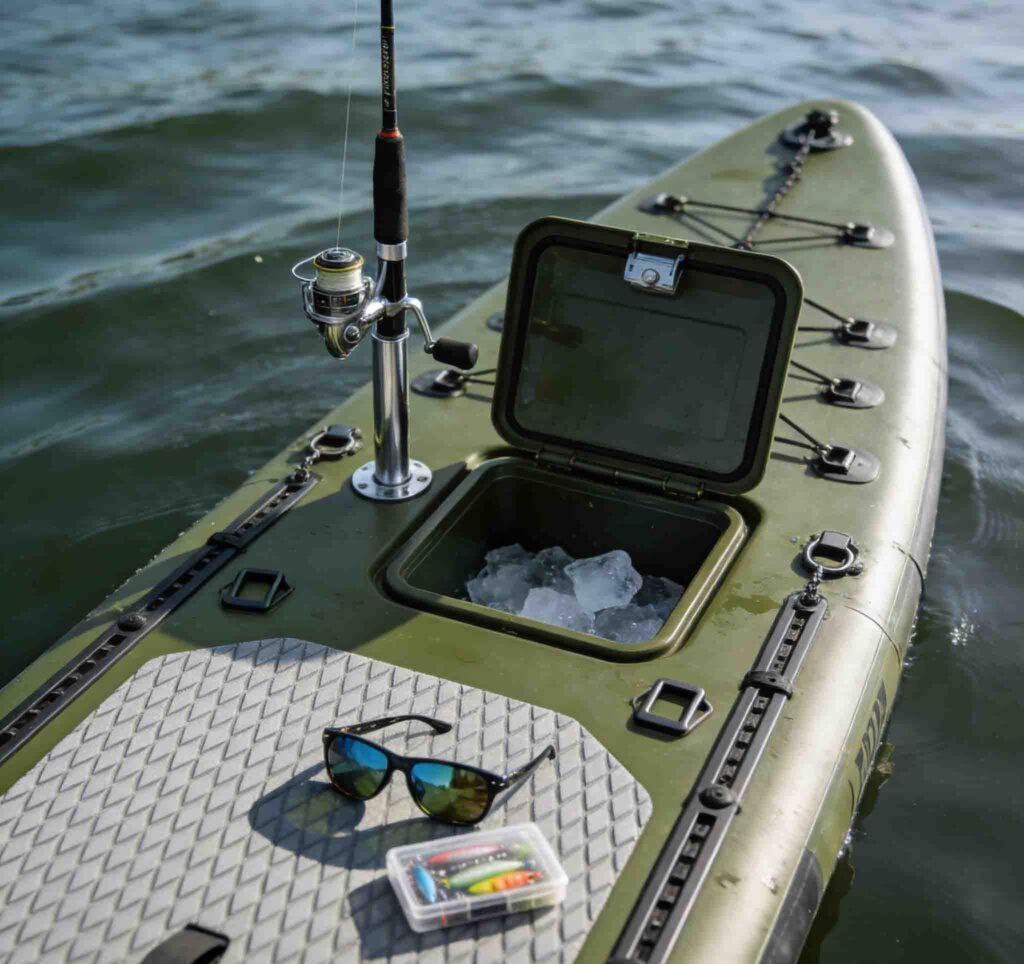
- Rod Holders: Look for flush-mounted, rotating holders made from stainless steel or reinforced polymer. Avoid cheap plastic clips that snap. Ideally, you want one in front for trolling and one behind for active casting.
- Livewell/Cooler Integration: Does the board have a dedicated, insulated well? Is it drainable? A true fishing-focused design will have a molded compartment that fits a standard soft cooler, often with bungees to secure it.
- Action Cam & Gear Mounts: Standard ¼”-20 and M8 threaded inserts allow you to easily attach camera arms, cup holders, and other accessories without messy adhesive pads.
Case Study: The “All-Day Comfort” Test
We surveyed 150 anglers who spent 6+ hours on their boards. 85% ranked “deck pad comfort and texture” as equally important as stability. A full-length, diamond-stitch EVA pad provides cushioning and grip, even when wet. A cheap, thin pad leads to sore feet and a slippery surface – a hidden deal-breaker.
3. Weight Capacity & Deck Space: Room for Your Adventure
Manufacturer weight limits are optimistic. Here’s the real math: Your Weight + 25 lbs (PFD, Clothing) + 40 lbs (Cooler with drinks/fish) + 20 lbs (Tackle Bag) = Minimum Required Capacity.
If you weigh 200 lbs, you need a board rated for at least 285 lbs. Aim for a board with 100+ lbs of extra capacity for optimal performance. A overloaded board sits low, paddles poorly, and becomes unstable.
4. Fish Finder Compatibility: Your Eyes Underwater
Modern fishing in a paddle boat is tech-enabled. Ensure your board has a solution for your fish finder.
- Scotty or RAM Mount Compatible: The most flexible system. Allows you to attach a finder’s display on a removable arm.
- Transducer Mount: Look for a through-hull scupper hole or an internal groove to route the transducer cable cleanly, keeping it protected and out of the way.
- Battery Storage: A small, waterproof compartment for a 12V battery is a premium feature that eliminates clumsy battery boxes on deck.
5. The Paddle: Your Most Critical Connection
Never buy a board that comes with a cheap, non-adjustable aluminum paddle. It’s like buying a sports car with bicycle tires. Your paddle is your engine and rudder.
Invest in a 3-piece adjustable carbon fiber or fiberglass paddle. It’s lighter (reducing fatigue by up to 40% over a day), stronger, and allows you to fine-tune the length. Partnering with a reputable fishing paddle manufacturer like Havenseek ensures you get a paddle specifically balanced for the weight and use-case of a loaded fishing paddle board, not a generic surfing model.
Your Perfect Match: A 4-Step Selection Framework
Now, let’s turn this knowledge into a decision. Follow this framework to eliminate confusion.
Step 1: Diagnose Your Primary Fishing Scenario
Be brutally honest. Where will you use this board 80% of the time?
- Small Ponds & Calm Lakes: Any stable board works. Prioritize features and budget.
- Large Reservoirs & Coastal Bays: You may cover distance. Prioritize tracking efficiency (good fin setup, longer board shape) and consider solid board performance.
- Rivers with Mild Current: Maneuverability is key. A shorter, wider board with a removable center fin is ideal.
Step 2: Honestly Assess Storage & Transport
This is the most common mistake. Ask yourself:
- Do I have a garage, shed, or large indoor wall space?
- Do I own a truck, SUV, or a car with a roof rack?
- Will I need to fly with this board?
If you answered “No” to #1 and #2, your path is clear: an inflatable fishing paddle board is your only practical choice.
Step 3: Set Your Performance vs. Budget Priority
Allocate your budget wisely.
- Budget-Friendly (~$800): Expect a quality inflatable with basic fishing features. It will be heavier and the accessories may be simpler.
- Best All-Around ($1,200 – $1,800): This sweet spot gets you a top-tier inflatable or entry-level solid board with excellent features, lighter weight, and better materials.
- Performance Premium ($2,000+): Ultra-light carbon construction, premium accessories, and custom rigging options. For the enthusiast or professional guide.
Step 4: Decode the Specification Sheet
Look past the marketing photos. Find the spec sheet and focus on:
- Dimensions: Length x Width x Thickness (e.g., 11’6″ x 34″ x 6″).
- Weight Capacity: The real number, calculated as above.
- Board Weight: Lighter is better, especially for inflatables you’ll carry.
- Core Material: “Drop-Stitch PVC” (inflatable) or “EPS Core with Epoxy” (solid).
- Accessory List: Are the fishing mounts included or sold separately? This can add $200+ to your cost.
Partnering with the Right Source: It’s More Than Price
If you’re a retailer, outfitter, or buying in volume, who you buy from is as important as what you buy.
Why a Specialized Fishing Manufacturer Matters
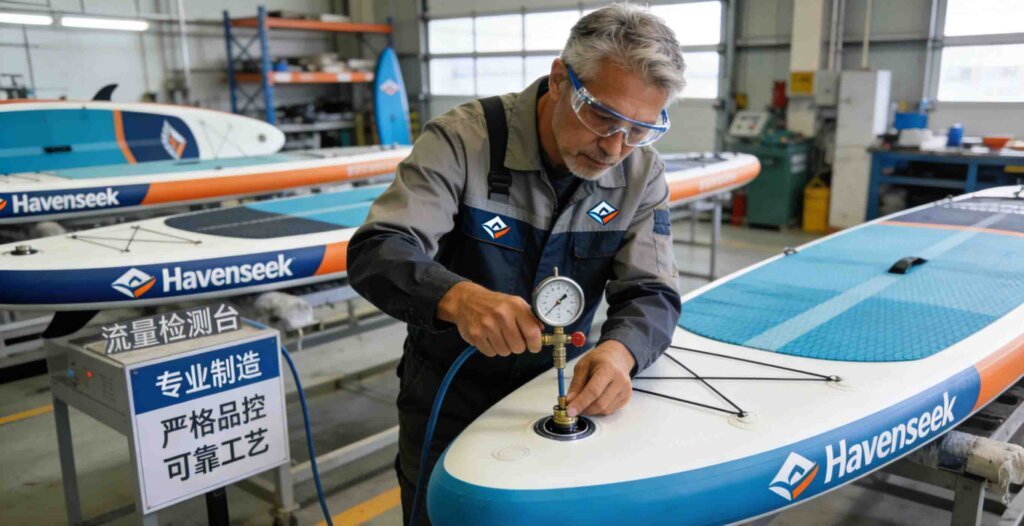
A generic paddle board factory sees fishing features as an afterthought. A true fishing paddle manufacturer like Havenseek designs from the angler’s perspective. This means:
- Corrosion-Resistant Hardware: Stainless steel D-rings and brass grommets that won’t rust in saltwater.
- Thoughtful Layout: Forward mounting points for an anchor trolley system, positioned for optimal drift control.
- Field-Tested Designs: Products are tested by actual anglers in real conditions, not just in a showroom.
5 Must-Ask Questions for B2B Buyers & Large Orders
- “What is your Minimum Order Quantity (MOQ) for custom color or logo application?” (This can range from 50 to 200 units).
- “Can you provide test reports for material tensile strength and air-holding pressure?” A professional manufacturer will have these.
- “What is your standard warranty for commercial/rental use, and what is the process for claims?” Look for at least a 2-year commercial warranty.
- “Do you offer mixed container loading with other fishing tackle?” This can drastically improve your overall sourcing efficiency.
- “Can you connect me with an existing client in a similar market for a reference?” A confident supplier will have satisfied partners.
Conclusion & Your Confident Next Step
Choosing the perfect fishing paddle board is no longer a guessing game. You now understand the fundamental trade-off between inflatable convenience and solid performance. You can identify the five features that transform a simple board into a serious fishing platform. Most importantly, you have a proven, four-step framework to match a board to your unique needs, avoiding expensive regrets.
The path to silent, stealthy, and successful fishing in a paddle boat is clear. You’re equipped not just to buy a board, but to invest in countless memorable days on the water.
Ready to Specify Your Perfect Fishing Paddle Board?
Whether you’re an individual angler seeking the ideal model or a business looking to source a reliable, high-margin line of fishing SUPs, our team at Havenseek is here to help. We combine deep manufacturing expertise with real-world angling passion.
Get Your Personalized 2026 Fishing SUP Sourcing Guide & Quote. Our experts will review your needs and provide tailored recommendations within 12 hours.Get My Free Quote & Consultation in 12 Hours
Frequently Asked Questions (FAQ)
Q: Is an inflatable fishing paddle board really stable enough for standing and casting?
A: Absolutely, if you choose correctly. Modern drop-stitch inflatables at 15-20 PSI are incredibly rigid. A board that is at least 34 inches wide and 6 inches thick will provide exceptional stability, comparable to many hard boards. The key is proper inflation – always use a pressure gauge.
Q: What’s the biggest mistake first-time buyers make?
A: Underestimating weight capacity and overestimating storage space. Buyers get seduced by a low price or cool graphics, only to find the board sinks too low with their gear or they have nowhere to put the 12-foot behemoth. Use our capacity formula and be brutally honest about your storage before purchasing.
Q: How important is the paddle, and should I upgrade?
A: It’s the most important accessory. The stock paddle is often heavy aluminum. Upgrading to a lightweight carbon fiber paddle from a reputable fishing paddle manufacturer reduces fatigue by up to 40%, making your entire day more enjoyable. It’s the first upgrade we recommend.
Q: Can I use a regular SUP for fishing?
A: You can, but you’ll be handicapping yourself. A dedicated fishing paddle board has integrated rod holders, attachment points, a more stable shape, and often a superior deck pad. Trying to add these features to a yoga or touring SUP is messy, insecure, and less effective. The investment in a purpose-built board is worth it for serious anglers.
Q: As a retailer, what’s a typical MOQ for custom-branded boards?
A: Minimum Order Quantities vary by manufacturer. For established brands like Havenseek, MOQs for custom color or logo application typically start between 50 and 100 units per model. This allows for cost-effective production while giving retailers a manageable inventory commitment. Always ask about mixed-container options to combine SKUs.
Further Reading & Resources
- Paddling Magazine: How to Choose a Fishing Paddle Board – A comprehensive buyer’s guide focusing on key features.
- Outside Business Journal: The Economics of Outdoor Gear Rentals – Analysis on managing fleet profitability and customer satisfaction.
- Take Me Fishing: Essential SUP Fishing Tips & Techniques – A great resource to share with your customers for a better on-water experience.