Welcome To HavenseeK Fishing Tackle

Pro Guide Reviews Top Saltwater Lures: What Really Works

Written by Captain Mike Sutton – With over 15 years and 3,000+ charter days as a professional saltwater fishing guide in the Gulf of Mexico, Mike has personally tested every major brand of saltwater fishing bait under the harshest conditions. He now leads product testing for Havenseek Tackle, translating real-world performance into better gear for anglers worldwide.

Table of Contents
- Why Trust a Guide’s Word on Saltwater Fishing Bait?
- The Workhorses: Jigs & Metal Baits That Never Let Us Down
- The Imitators: Soft Plastics That Out-Fish Live Bait (Sometimes)
- Topwater & Hard Baits: The Adrenaline Rush, Analyzed
- The Guide’s Ultimate Selection & Maintenance Framework
- Conclusion: Performance Over Hype
- Frequently Asked Questions (FAQ)
- Further Reading & References
Why is this article worth 20 minutes of your time? Because the advice here isn’t based on marketing or a single lucky trip. It’s condensed from thousands of hours of punishing, real-world testing where the right saltwater fishing bait means putting clients on fish and the wrong one means a lost income. I’ve seen lures that promise the world snap on the first strike, and humble jigs that catch fish year after year. This guide will save you hundreds of dollars in wasted purchases and countless hours of frustration by giving you the unvarnished truth about what artificial saltwater fishing bait actually performs when it matters most.
Why Trust a Guide’s Word on Saltwater Fishing Bait?
Let’s be brutally honest. The average weekend angler might use a handful of lures over a season. A serious tournament fisherman will put them through the wringer. But a full-time saltwater guide? We are the ultimate, unforgiving beta test. In a single week during peak season, I might make 10,000 casts, hook 200 fish, and expose my gear to blistering sun, barnacle-encrusted structure, and saltwater corrosion that would make a naval engineer wince. When I recommend a saltwater fishing bait
My criteria are simple, ruthless, and commercial:
- Durability: Does it last more than one fish? Can it handle a 40-inch redfish or a missed cast on an oyster bed?
- Consistency: Does it produce day in, day out, regardless of client skill level?
- Cost-Effectiveness: Is it a tool that delivers value, or an expensive trinket?
- Versatility: Can it adapt to changing tides, weather, and target species?
This guide is that distilled knowledge. Let’s get into the tackle box.
The Workhorses: Jigs & Metal Baits That Never Let Us Down
The Undisputed King of Versatility
If my boat was sinking and I could grab only one type of saltwater fishing bait, it would be a selection of jigs. Period. Their simplicity is their genius. A weighted head, a hook, and often a skirt or soft plastic trailer. This combination allows for infinite presentations.
Why Guides Live and Die by the Jig:
- All-Depth Capability: You can fish it vertically over a wreck, hop it on a flat, or swim it mid-column.
- Species Agnostic: From speckled trout and flounder to snapper and grouper, everything eats a jig.
- Inexpensive & Replaceable: Losing a $5 jig to a reef is a business expense. Losing a $25 swimbait hurts.
Captain’s Pick #1: The 1oz Ultra-Minnow Jig
This isn’t a specific brand, but a style. It features a sleek, bullet-shaped head, a ultra-sharp 5/0 hook, and a simple epoxy eye. I’ve used versions from multiple manufacturers, and the good ones share these traits.
Pros:
- Unmatched sink rate for getting deep fast in current.
- Clean design avoids snags in rocky structure.
- The hook point is almost always exposed for solid hooksets.
Cons:
- Requires a trailer (soft plastic) for best action, an added cost.
- Plain finish may not trigger fish in ultra-clear water without motion.
Real-World Test: Last summer, targeting mangrove snapper on deep-water artificial reefs off Alabama. The current was ripping. A 1oz jig with a small curly-tail grub got to the strike zone instantly and stayed there, while heavier, bulkier lures were swept away. We boxed limits when other boats struggled.A selection of 1oz bullet-head saltwater jigs in various colors lying on a weathered marine-grade cutting board, next to a pair of used fishing pliers.
Captain’s Pick #2: The Diamond-Style Jig (Heavy Metal)
When the pelagics are busting bait on the surface, or you need to search vast water columns quickly, nothing beats a diamond jig. Its frantic, fluttering fall imitates a dying baitfish perfectly.
Key Evaluation Points for Metal Baits:
- Fall Rate & Action: Does it “swim” as it sinks, or just tumble?
- Finish Durability: Does the reflective coating peel after a few bluefish?
- Hook & Ring Quality: This is the #1 failure point. Must be welded or solid.
The Imitators: Soft Plastics That Out-Fish Live Bait (Sometimes)
The evolution of soft plastic saltwater fishing bait has been revolutionary. We now have baits so realistic in action and scent that, in many scenarios, they outperform live shrimp or pilchards—especially when finicky fish are pressured.
The Anatomy of a Killer Soft Plastic
Forget the color for a moment. The magic is in the design and material.
| Feature | Why It Matters | Guide’s Priority |
|---|---|---|
| Tail Design (Paddle, Curly, Swimbait) | Creates vibration/thumping action that fish detect with lateral lines. | High – The right tail for the retrieve speed is crucial. |
| Plastisol Formula | Determines softness, durability, and salt/UV resistance. | Highest – A brittle bait is a wasted bait. Elasticity is king. |
| Scent Impregnation | Triggers a feeding response and encourages fish to hold on longer. | Medium-High – Critical for slow presentations and bottom fish. |
| Realistic Sculpting | Visual trigger for clear-water, sight-fishing scenarios. | Medium – Action and profile are often more important than ultra-realism. |
The “Paddle Tail” Swimbait System: A Case Study
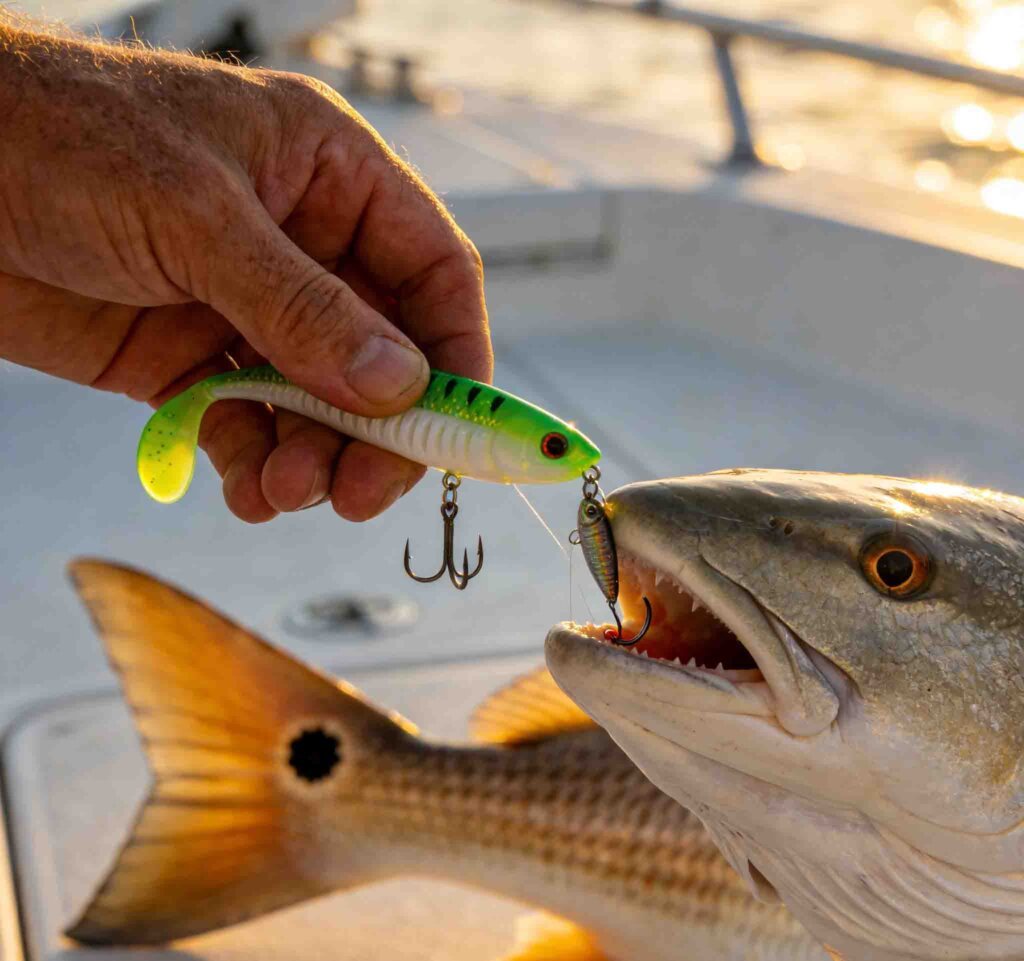
This is the most significant innovation in inshore fishing in the last decade. A weighted jig head (usually 1/4 to 3/4 oz) paired with a soft plastic shad body with a kicking paddle tail.A close-up of a hand holding a successfully rigged paddle tail swimbait next to a large, caught redfish, showing the perfect hook placement.
Why it dominates: It combines the searchability of a hard bait with the natural feel of soft plastic. You can burn it, slow roll it, or bounce it off the bottom. The tail puts out a steady thump that draws strikes from ambush predators like snook and seatrout.
Guide’s Configuration: I use a 4/0 extra-wide gap hook on a 1/2 oz bullet head for 90% of my inshore swimbait fishing. The key is matching the jig head weight to the depth and current—too light, and you can’t control the presentation; too heavy, and the action dies.
Topwater & Hard Baits: The Adrenaline Rush, Analyzed
The Science of the Surface Strike
Topwater fishing is pure theater. But for a guide, it’s not just about the explosion; it’s a strategic tool for covering water and triggering otherwise passive fish.
Topwater Bait Categories Decoded:
- Walk-the-Dog (Pencil Poppers): Side-to-side “S” action. Excellent for calm water and aggressive fish like jack crevalle and juvenile tarpon. Requires a rhythmic rod tip motion.
- Chuggers/Poppers: Create a splash and “bloop” sound. Ideal for rough water or low light to create a commotion. Great for snook around dock lights.
- Prop Baits: Front and/or rear props create a buzzing sound and bubble trail. Fantastic search baits early in the morning over grass flats.
The Overlooked Hero: The Suspending Twitch Bait
While not a topwater, this hard bait deserves mention. A suspending jerkbait (like a MirrOlure 52MR) is a killer in cooler water or for super-clear backcountry spots. Cast it, let it sit motionless for up to 10 seconds, then give it a subtle twitch. The erratic, wounded-minnow action is irresistible to trout and reds.
Maintenance Tip: These lures are precision-tuned. Always check the hook hangers for rust and replace the stock split rings with stronger, coated ones. A drop of super glue on the screw-lock can save you from losing a trophy.
The Guide’s Ultimate Selection & Maintenance Framework
Building a No-Waste, High-Impact Saltwater Bait Arsenal
You don’t need 500 lures. You need 10 proven ones in the right sizes and colors. Here’s a data-driven starting point for anglers in the Southeast US Gulf Coast region.
| Primary Target Species | #1 Recommended Bait Type | Specific Suggestion & Size | Best Conditions |
|---|---|---|---|
| Redfish (Red Drum) | Paddle Tail Swimbait | 4″ Paddle Tail on 1/4-1/2 oz Jig Head (Gold/Black Flake) | Moving water over grass or oyster beds. |
| Speckled Trout | Soft Plastic Shrimp Imitator | 3″ Curly-Tail Grub on 1/8 oz Jig Head (Electric Chicken) | Low light, around current breaks and potholes. |
| Snook | Topwater Walk-the-Dog | 5″ Floating Pencil Popper (Bone/White) | Dawn/Dusk, around mangroves and dock lights. |
| Nearshore Grouper/Snapper | Bucktail Jig | 1-2 oz White Bucktail with Live Bait Strip | High-relief bottom structure (reefs, wrecks). |
| Spanish Mackerel/Bluefish | Diamond/CAST Jig | 1 oz Chrome Jig with Stinger Hook | Birds working over bait schools. |

The 10-Minute Post-Trip Ritual That Doubles Lure Life
This isn’t optional; it’s business. Salt is a destroyer of gear and profits.
- Rinse: Dunk ALL lures (even those still in the box) in a bucket of freshwater. Swish hard baits to get salt out of hook hangers.
- Dry: Lay them out on a dry towel in the shade, not direct sun which degrades plastic.
- Inspect: Check hooks for rust or dullness. Check split rings for opening. Check soft plastics for tears.
- Lubricate: A tiny drop of corrosion inhibitor (like Boeshield T-9) on moving parts of hard baits.
An organized, compartmentalized tackle box showing clean, well-maintained saltwater lures arranged by type.
Conclusion: Performance Over Hype
The world of saltwater fishing bait is full of flashy packaging and bold claims. But on the water, only performance pays the bills. The lures and systems I’ve outlined here are not necessarily the most expensive or the most advertised. They are the ones that, day after day, season after season, have proven they can take a beating and put fish in the boat. They are tools, not toys.
Your takeaway should be this: Simplify, specialize, and maintain. Invest in a small selection of proven, durable saltwater fishing bait types that match your local fishery. Learn their nuances inside and out. And treat them like the professional assets they are. Do this, and you’ll out-fish the angler with a boat full of untested, shiny new objects every single time.
Ready to Equip Your Business with Guide-Approved Gear?
At Havenseek Tackle, we don’t just sell lures—we engineer them based on feedback from professionals like Captain Mike. We offer bulk and wholesale pricing on our entire range of tested, proven saltwater fishing bait.
► Request Your Free 2025 Saltwater Bait Sample Kit & Wholesale Catalog
Get hands-on with our top-performing jigs, swimbaits, and soft plastics. See and feel the difference that professional-grade materials and design make. Submit an inquiry today, and our team will get your sample kit and pricing details to you within 12 hours.
Frequently Asked Questions (FAQ)
What is the most versatile type of artificial saltwater fishing bait?
For sheer versatility across different depths, species, and conditions, a 1-ounce bucktail jig paired with a soft plastic trailer is hard to beat. It can be bounced for bottom species, swam for predators in the mid-water column, and even ripped for reaction strikes.
How long should a quality saltwater soft plastic bait last?
A well-made, durable saltwater soft plastic should survive 5-10 fish catches on average before the tail is shredded or the body is compromised. Some premium, super-elastic formulas can last for 20+ fish, making them far more cost-effective than cheap, brittle baits that last one or two bites.
Are expensive saltwater lures always better?
Not necessarily. While you often pay for better components (hooks, rings, paint) and R&D, the most critical factor is matching the lure to the specific conditions and presentation. A $5 jig in the right spot will outperform a $30 lure in the wrong one. Focus on proven designs from reputable manufacturers rather than price alone.
What’s the #1 mistake anglers make with artificial saltwater bait?
Impatience. The most common error is retrieving the lure too fast. Artificial baits often imitate wounded or struggling prey. A slower, more erratic retrieve with frequent pauses is usually far more effective, especially for species like redfish, snook, and grouper.
How do I choose the right color for my saltwater fishing bait?
Follow this simple rule: Bright colors (chartreuse, white, pink) for murky water and low light; natural colors (baitfish patterns, greens, browns) for clear water and bright light. When in doubt, a simple white or bone color is a universally effective starting point.
Can I use freshwater lures for saltwater fishing?
It’s not recommended. Saltwater fishing bait and lures are specifically engineered with corrosion-resistant components (hooks, split rings, wire), stronger construction, and often more vibrant UV-resistant paints to handle the abrasive, corrosive marine environment. Freshwater lures will fail quickly.
What is the best all-around weight for a saltwater jig?
For inshore fishing (flats, bays, channels), 1/4 oz to 3/4 oz covers most situations. For nearshore/offshore (reefs, wrecks), 1 oz to 3 oz is standard. The goal is to use the lightest weight that maintains bottom contact or reaches the desired depth in the current.
How important is scent on artificial saltwater baits?
Extremely important for slower-moving presentations and bottom species. Scent can trigger hesitant fish to hold on to the bait a second longer, giving you time to set the hook. It’s less critical for fast-moving reaction baits like topwaters or poppers.
Should I replace the hooks that come on my saltwater lures?
Yes, often. While many premium lures come with excellent hooks, it’s a best practice to immediately upgrade the split rings and trebles on any hard bait you rely on. Use chemically sharpened, high-carbon steel or forged hooks for significantly better penetration and durability.
What’s the best way to store artificial saltwater bait after use?
Rinse all lures thoroughly with freshwater after every trip. Let them dry completely. Store soft plastics in their original bags to prevent them from melting or leaching plasticizer. Store hard baits in compartmentalized boxes to prevent paint scratches and hook tangles.
Further Reading & References
To deepen your knowledge on selecting and using saltwater fishing bait, consider these authoritative resources:
- NOAA Fisheries: Understanding Fish Habitat – The foundation of all successful bait selection is understanding where fish live and why.
- Florida Fish and Wildlife Conservation Commission Saltwater Fishing – A prime example of GEO-localized regulations, species info, and reports critical for bait selection in a major market.
- Salt Water Sportsman: How to Choose Offshore Trolling Lures – A trusted magazine’s take on a specific, high-stakes bait category.