Welcome To HavenseeK Fishing Tackle

Custom Jointed Swimbaits: 7 Fixes for Private Label Glide Baits
You placed a 3,000-piece order for custom jointed swimbaits. The samples looked perfect. The factory video showed that seductive S-swim. But three weeks after launch, your inbox fills up: joints popping loose, paint flaking off after one outing, hooks rusting in the package. Returns spike. Ad spend burns. That $12,000 container order now feels like a $12,000 lesson.
I have watched this exact scenario play out more than a hundred times. Not because factories are dishonest. Because buyers and factories are speaking different languages when it comes to private label glide baits specifications. Nobody is checking the joint pull force. Nobody is running a salt spray test. Nobody is calculating the true landed cost of unpainted swimbait blanks wholesale before committing.
This article fixes that. In the next few minutes, you will learn exactly how to test joints before you pay, how to calculate the hidden cost of blank finishing, how to write an OEM spec sheet that prevents 90% of common failures, and how to run a low MOQ first order that actually sells through. I have personally inspected thousands of production runs on the factory floor, and every number in this article comes from that experience.
Here is why this is worth your time: the global fishing lures market grew from USD 3.41 billion in 2025 to USD 3.62 billion in 2026, and it is projected to hit USD 5.35 billion by 2032 at a 6.66% CAGR. This category is not slowing down. But the brands that win are the ones that treat sourcing like engineering, not like shopping.
Quick summary:
- Test joints at 22–25kg pull force before approving bulk production
- Calculate real blank cost with the 7-variable formula below
- Specify 304/316 stainless for saltwater, 48–96 hour salt spray minimum
- Start with 300–500 pieces across 2–3 colors for first orders
- Confirm packaging MOQ separately from product MOQ
1. Why 2026 Sourcing Is Harder Than It Looks
Three forces are squeezing B2B lure buyers right now. Tariffs, freight volatility, and a consumer base that researches through AI before they ever visit your product page.
The tariff picture alone has been brutal. In May 2025, the US and China agreed to a 90-day pause that brought the tariff on Chinese imports down from 125% to a baseline rate of 10%. But uncertainty remains. A sourcing agent in Weihai with 30 years of experience told trade press that Chinese factories were already reacting to a world where new orders from the USA had stopped. For buyers, this means smaller test orders, faster turns, and a premium on getting the spec right the first time.
Meanwhile, your end customer has changed. According to Gartner data from 2026, 45% of B2B buyers used generative AI in their most recent purchase, mostly to gather provider information. And 69% then take the AI’s findings to a salesperson to validate them. If your product data is not structured for AI to find and quote, you are invisible at the exact moment a buyer is building their shortlist.
$5.35B
Projected fishing lures market by 2032
6.66%
CAGR 2026–2032
45%
B2B buyers using AI in purchases
2. Private Label Glide Baits: 7 Real Reasons They Get Returned
I have reviewed hundreds of return reports from brands selling private label glide baits. The complaints cluster into seven buckets. Every single one is preventable before the container ships.
2.1 Swimming Action Mismatch
The sample you approved was hand-tuned. The production run came off a mold that had already cycled 5,000 times. The result: a glide bait that tracks left instead of gliding in a wide S-pattern. Fix: Require a pre-production sample from the actual production mold, not a prototype mold. Film it in the same water conditions you will demo to customers.
2.2 Joint Loosening and Pin Wear
Joint connections use either metal pins, wire loops, or woven fabric. Metal pins wear down faster than woven fabric joints. One popular multi-section swimbait uses an internal woven fiber rated at 40 pounds break strength and tested up to 100 pounds in real conditions. That is the durability standard your customers expect.
2.3 Paint and Coating Failure
Saltwater UV exposure breaks down cheap paint in weeks. A freshwater lure might last a season on a shelf; a saltwater one needs UV stabilizers in the clear coat. Fix: Specify 3M tape adhesion test — three pulls, no paint lift.
2.4 Weight Deviation and Buoyancy Drift
If your OEM multi jointed fishing lures have a ±2g weight variance, a slow-sinking lure becomes a floater in warm water. Fix: Write ±0.5g tolerance into the spec sheet and request per-batch weight reports.
2.5 Hook Corrosion
This is the silent killer. Research on fishing hook corrosion shows that 98 hours of salt spray exposure is roughly equivalent to one year of marine use, and hooks are commonly tested for 300 hours under ASTM B117. If your factory only runs a 24-hour test, your hooks will rust on the retail shelf, not after use.
2.6 Packaging Damage in Transit
Private label glide bait packaging often fails the drop test. Header cards crease. Blister packs crack. Retailers reject shipments. Fix: Require 1.2m drop test on 10 random units before shipment.
2.7 Retail Display Hanging Hole Misalignment
I saw a brand lose 30% of a retail chain order because the hanging holes were 3mm off. The pegs would not hold. The entire batch was refused at the warehouse. Fix: Send your exact peg dimensions to the packaging supplier and request a physical mock-up before printing.
Pre-order verification checklist (12 points):
- Joint pull force at 20kg+
- Hook hanger pull force at 25kg+
- Salt spray test report
- Paint adhesion test
- Weight tolerance report
- Swim action video from production mold
- Packaging drop test
- Hanging hole alignment
- Barcode and label accuracy
- Color consistency against Pantone
- Quantity count verification
- Individual unit weight check
3. OEM Multi Jointed Lure Joint Testing Before You Order 5,000 Pieces
Here is the hard truth: your sample being strong means almost nothing. A hand-assembled sample can be twice as strong as the production line version. You need to test the production process, not the prototype.
3.1 Joint Structures and Their Real Costs
| Joint Type | Typical Cost Impact | Durability Rating | Best For | Risk |
|---|---|---|---|---|
| Steel Pin | Baseline | Medium | Freshwater bass | Rust, pin wear |
| Wire Loop | +15–25% | Medium-High | Mixed use | Water intrusion |
| Woven Fabric / Mesh | +30–40% | High | Saltwater, big fish | Higher unit cost |
3.2 The Pull Test Protocol
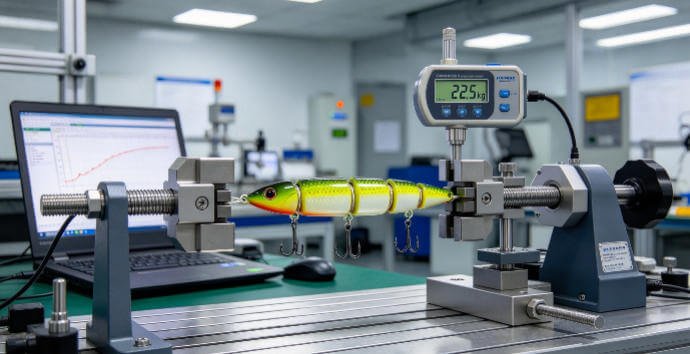
Ask your supplier to perform this test on 10 randomly selected units from the production line:
- Static pull test: Clamp the lure head and tail. Apply 15kg, hold 30 seconds. Then 20kg, 30 seconds. Then 25kg, 30 seconds. Record at what force the joint deforms or separates.
- Fatigue test: Swing the lure through 1,000 full cycles at normal fishing speed. Inspect for cracks, loosening, or water infiltration.
- Hook hanger test: Same protocol on the line tie and hook hangers. Saltwater species can exceed 25kg of instantaneous force on a strike.
My rule of thumb after 18 years on factory floors: If a production-run OEM multi jointed fishing lure cannot survive a 22kg static pull on the joint and a 25kg pull on the hook hanger, do not ship it. I do not care what the sample did. I care what the 4,000th unit off the line does.
3.3 What to Put in Your Purchase Contract
Write this clause verbatim: “Seller guarantees joint assembly pull strength of minimum 20kg and hook hanger pull strength of minimum 25kg, tested per buyer’s protocol on 10 randomly sampled units per batch. Failure of more than 1 unit triggers 100% inspection and replacement at seller’s cost.”
That single sentence has saved my clients more money than any price negotiation.
4. Unpainted Swimbait Blanks: The Hidden Cost Nobody Calculates
I get it. Unpainted swimbait blanks wholesale looks like a shortcut. A blank might cost $0.60 while a finished lure costs $2.20. But that $1.60 gap is not profit. It is work you are about to do yourself, and most buyers underestimate it by 40%.
4.1 The Real Cost Formula
Real cost per unit = Blank price + Painting labor + Paint materials + Assembly labor + Loss rate × unit cost + Rework rate × unit cost + Packaging cost + QC time
4.2 Real Numbers From a 1,000-Piece Run
| Cost Item | Low Estimate | High Estimate | Notes |
|---|---|---|---|
| Blank unit price | $0.55 | $0.90 | Depends on size and joint count |
| Painting labor | $0.35 | $0.80 | Per unit, skilled airbrush work |
| Paint materials | $0.15 | $0.40 | Primer, base coat, clear, UV |
| Assembly labor | $0.20 | $0.45 | Hooks, rings, joint assembly |
| Loss rate (8–15%) | $0.12 | $0.28 | First 3 batches run higher |
| Rework rate (5–12%) | $0.08 | $0.22 | Paint defects, joint issues |
| Packaging | $0.10 | $0.35 | Bag, card, label |
| Total real cost | $1.55 | $3.40 | vs. factory painted at $2.20–$2.80 |
At low volume, buying finished lures from the factory is almost always cheaper. Unpainted swimbait blanks wholesale only makes sense when you have an in-house painting line running at high utilization, or when you are selling a “paint-it-yourself” product to hobbyists.
Critical mistake: Do not compare blank unit price to finished lure unit price. Compare real cost to real cost. I have seen buyers lose $4,000 on a “cheap” blank order because they forgot to count the 15% loss rate and the 12% rework rate. That is not a sourcing win. That is a math problem.
5. Low MOQ Custom Swimbaits: From Sample to First Sale Without Dead Inventory
The worst outcome for a first order is not a quality problem. It is a warehouse full of lures that do not sell. Low MOQ custom swimbaits exist so you can test the market, learn fast, and scale the winners. But only if you plan the test correctly.
5.1 First Order Sizing: The 300–500 Rule
I recommend 300 to 500 pieces total across 2 to 3 colors for a first order. Not 10 SKUs. Not 5,000 pieces. Here is why: you need enough units to measure sell-through, but not so many that a wrong bet sinks your cash flow.
Too Small (under 200)
Not enough data to measure reorder rate. Promotions sell out too fast. You learn nothing.
Not enough data to measure reorder rate. Promotions sell out too fast. You learn nothing.
Sweet Spot (300–500)
Enough for 30-day sell-through data. Low cash risk. Fast reorder cycle.
Enough for 30-day sell-through data. Low cash risk. Fast reorder cycle.
Too Large (over 1,000)
High inventory risk on unproven SKUs. Cash locked in slow movers.
High inventory risk on unproven SKUs. Cash locked in slow movers.
5.2 The Sampling Timeline
| Stage | Time Needed | What You Approve |
|---|---|---|
| Reference sample from existing mold | 5–10 days | Shape, size, joint count |
| Custom color sample | 7–14 days | Paint scheme, UV, glow |
| Packaging mock-up | 5–10 days | Card layout, bag size, barcode |
| Pre-production sample | 7–10 days | Full assembly from production mold |
| Mass production | 30–45 working days | — |
Do not compress the pre-production sample step. I have seen buyers skip it to save two weeks, then spend two months dealing with returns. Sample costs typically run $30 to $150 for reference samples, and $50 to $300 for custom colors or finishes.
5.3 The 30-Day Post-Launch Review
After your first batch goes live, track these five numbers:
- Sell-through rate: Target 60%+ in 30 days. Below 40% means pricing or channel mismatch.
- Return rate: Target under 3%. Above 5% means a quality issue worth investigating.
- Review keywords: Scan for “joint,” “paint,” “rust,” “weight.” These tell you exactly what to fix.
- Reorder velocity: How fast do repeat buyers come back? This is your true product-market fit signal.
- Channel performance: Amazon vs. Shopify vs. local retail. Double down on the winner.
Case study — from 500-piece trial to 2,000-piece reorder:
A US-based independent brand ordered 500 low MOQ custom swimbaits in two colors. Thirty days later, sell-through hit 78%. Return rate was 2.1%. The only complaint pattern was a slightly loose joint on the 5-inch model after 200+ casts. The second order adjusted the joint pin diameter by 0.3mm and increased to 2,000 pieces, adding two private label glide baits to the same container. Same freight cost. Triple the revenue per container.
A US-based independent brand ordered 500 low MOQ custom swimbaits in two colors. Thirty days later, sell-through hit 78%. Return rate was 2.1%. The only complaint pattern was a slightly loose joint on the 5-inch model after 200+ casts. The second order adjusted the joint pin diameter by 0.3mm and increased to 2,000 pieces, adding two private label glide baits to the same container. Same freight cost. Triple the revenue per container.
6. Freshwater vs. Saltwater OEM Spec Sheet: What to Write Before You Order
This is where most buyers lose money. They write “custom jointed swimbaits” on the purchase order and assume the factory knows the target environment. The factory does not know. You have to tell them.
| Specification | Freshwater | Saltwater |
|---|---|---|
| Hook / ring material | Nickel-plated carbon steel | 304 or 316 stainless steel |
| Joint pin material | Steel or brass | 316 stainless or woven Dyneema |
| Salt spray requirement | 24 hours, no red rust | 48–96 hours, no red rust |
| Clear coat | Standard epoxy | UV-stabilized epoxy, 2 coats |
| Hook wire gauge | Standard | Heavy, 25kg+ pull rated |
| Target swim depth | 0.5–1.5m | 3–8m |
| Weight tolerance | ±1.0g | ±0.5g |
For saltwater, the neutral salt spray test standard is QB/T 3826 (NSS method). Freshwater fittings require 24 hours with no visible red rust; saltwater fittings require 48 to 96 hours. Print that standard number on your purchase order. It removes ambiguity.
6.1 The OEM Brief Template
Every OEM multi jointed fishing lures order should include this information:
- Target species and average fish weight
- Fishing environment (fresh, salt, brackish)
- Target swim depth and retrieve speed
- Joint count and body length
- Weight and buoyancy (floating, slow sink, fast sink)
- Hook type, size, and pull rating
- Paint scheme with Pantone reference or physical sample
- Clear coat specification
- Packaging format and MOQ
- Testing requirements and acceptance criteria
7. Seven Mistakes That Kill First Orders
- Comparing unit price instead of landed cost. A $0.30 cheaper lure means nothing if 12% fail QC and you pay for return shipping.
- Skipping the pre-production sample. Saving two weeks here costs two months in returns.
- Ordering too many SKUs. Five colors feels safe. It is not. It is five bets, and you need four to win.
- Not specifying saltwater hardware. The factory defaults to freshwater unless you write it down.
- Treating packaging as an afterthought. Retailers reject shipments for 3mm misalignment. Packaging is product.
- No pull test protocol in the contract. Without a written standard, “strong enough” is whatever the factory decides.
- Skipping the 30-day review. Your second order should be smarter than your first. If it is not, you are burning cash.
8. FAQ: 10 Real Questions From B2B Buyers
What is the best MOQ for custom jointed swimbaits?
For a first market test, 300 to 500 pieces across 2 to 3 colors works well. Low MOQ custom swimbaits typically start at 500 pieces per color for painted versions and 200 pieces for unpainted swimbait blanks wholesale orders.
How do I test OEM multi jointed fishing lures before a bulk order?
Request a pull test on joints at 15kg, 20kg, and 25kg for 30 seconds each. Run a 1,000-cycle fatigue test. If any joint cracks or loosens, reject the batch. A 22–25kg joint tolerance is a reasonable minimum for saltwater use.
Are unpainted swimbait blanks cheaper than painted lures?
The unit price is lower, but total cost depends on your painting setup. Outsourced painting adds $0.80 to $1.50 per lure. At low volumes, factory-painted lures often cost less overall.
Can I get private label glide baits with my logo?
Yes. Logos can go on the lure body, retail packaging, or both. Custom printed bags start at 500 pieces; insert and header cards usually start at 1,000 pieces. Confirm packaging MOQ separately from product MOQ.
What causes joint failure in OEM multi jointed lures?
Weak pin material, poor joint alignment during assembly, water intrusion swelling the ABS body, and mismatched joint structure for the target fish species. Saltwater species generate forces that quickly destroy undersized joints.
How much does low MOQ custom swimbait sampling cost?
Expect $30 to $150 for a reference sample. Custom colors or finishes add $50 to $300. New tooling can cost $200 to $800, often waived if projected annual volume exceeds 50,000 units.
What saltwater hardware should I specify for custom jointed swimbaits?
Specify 304 or 316 stainless for hooks, rings, and pins. Require 48 to 96 hour salt spray with no visible red rust. Confirm the standard, such as ASTM B117 or QB/T 3826.
How long does private label glide bait production take?
After sample approval, 30 to 45 working days for production. Custom packaging adds 7 to 14 days. Sampling itself takes 7 to 30 working days depending on customization level.
Can I mix custom jointed swimbaits and glide baits in one order?
Yes, but MOQ applies per model and per color. Mixing formats in one container reduces freight costs. Confirm the factory can run both hard-body and soft-tail lines simultaneously.
How do I calculate the real cost of unpainted swimbait blanks wholesale?
Real cost = blank price + painting labor + paint materials + assembly labor + loss rate + rework rate + packaging. Track your first three batches carefully because the loss rate drops after the learning curve.
Conclusion: Sourcing Is Engineering, Not Shopping
The brands winning in custom jointed swimbaits are not the ones with the lowest unit cost. They are the ones with the tightest specifications, the most rigorous pre-shipment testing, and the clearest data on what sells. Private label glide baits succeed when you treat the joint pull force like a spec, not a suggestion. Unpainted swimbait blanks wholesale only pay off when you have calculated the real cost, not just the blank price. And OEM multi jointed fishing lures ship without drama when the purchase order reads like an engineering document.
The market is growing. AI search is changing how buyers find suppliers. The opportunity is real. But the entry price is discipline.
Ready to Source Custom Jointed Swimbaits the Right Way?
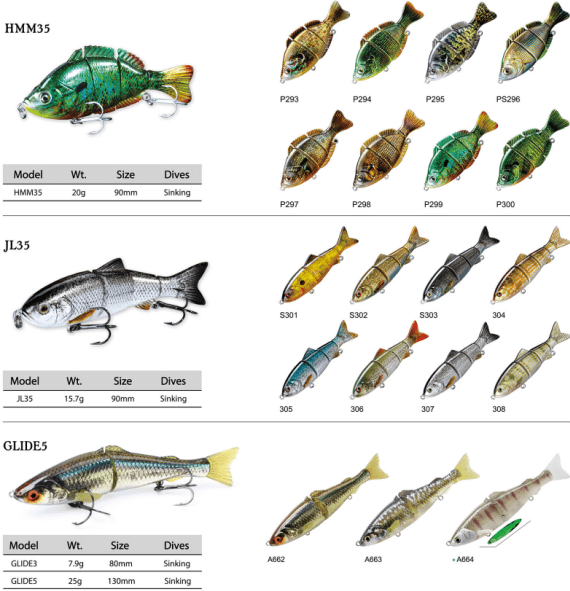
Get a detailed quote, request a free sample kit, or download our 2026 product catalog with full specifications for private label glide baits, OEM multi jointed lures, and unpainted swimbait blanks.
Free Quote in 12 Hours · Free Sample Kit Available · Low MOQ from 300 Pieces
Request Free Quote →