Welcome To HavenseeK Fishing Tackle

Inside a Treble Fish Hook Factory: How Quality is Forged (Not Just Made)

Inside a Treble Fish Hook Factory: How Quality is Forged (Not Just Made)
Your brand’s reputation hangs by a thread of high-carbon steel. Let’s see what it’s really made of.
Imagine this: A hot new lure brand gets its first 10,000-unit order. The product looks perfect. But within months, anglers report hooks straightening on decent fish, rust spots appearing after one saltwater trip, and points snapping off. The brand is flooded with returns, negative reviews tank their Amazon rating, and their hard-earned reputation is destroyed. All because of a component that cost less than a dime.
This isn’t a nightmare scenario; it’s a common story we hear from brands that come to us for rescue. The brutal truth? Most people buying treble fish hooks—whether as a component or a finished lure—are evaluating the wrong things. They look at price, maybe a sample’s initial sharpness, and a glossy brochure. They miss the invisible 80% that determines performance: what happens inside the factory.
This article is your backstage pass. I’ll show you how a premium treble fish hook is forged through engineering and control, not just made on an assembly line. You’ll learn to read a fishing hook size chart with the eyes of a designer, and you’ll have a concrete checklist to vet any fishing hook supplier. By the end, you’ll know why some hooks are commodities and others are critical components. This deep dive is worth your time because it translates directly to product reliability, fewer returns, and a stronger brand.
TL;DR – Key Takeaways Before We Dive In
- The Price Lie: 70% of a hook’s cost is in processes you can’t see (heat treatment, plating). Cheap hooks cut corners here.
- Size is a System: A fishing hook size chart is useless without knowing the gap, wire thickness, and point geometry it’s based on.
- Supplier ≠ Source: A true manufacturing partner provides process proof (test reports, metallurgical data), not just promises.
- Your New Superpower: You’ll be able to ask specific, technical questions that separate marketing from manufacturing reality.
- The Bottom Line: Consistency and controlled processes are what you’re really buying. This guide shows you how to verify them.
Table of Contents
- The Raw Edge: Where Premium Hooks Begin
- Steel Showdown: High-Carbon vs. Stainless
- Forming Precision: Where the Hook Takes Shape
- The Heart of Strength: Heat Treatment Secrets
- The Science of Sharp: Point Geometry
- The Shield: Corrosion Protection That Works
- Final Assembly: Machine Precision vs. Human Touch
- The QC Pyramid: Catching Defects Before You Do
- The Real Cost Model: Why Cheap is Expensive
- Case Study: From 8% Returns to Under 1.5%
- 3 Common & Costly Buyer Errors (And How to Avoid Them)
- Your Questions, Answered (FAQ)
Inside a Treble Fish Hook Factory: How Quality is Forged (Not Just Made)
Your brand’s reputation hangs by a thread of high-carbon steel. Let’s see what it’s really made of.
The Raw Edge: Where Premium Treble Hooks Begin
Every journey starts with a single step, and for a treble fish hook, that step is a coil of wire. But not all wire is created equal. The choice of material is the first and most fundamental decision that dictates performance, cost, and manufacturing path.
The Steel Showdown: High-Carbon vs. Stainless – It’s Not Just About Rust
Let’s demystify the biggest misconception head-on. Many buyers believe “stainless steel” is the premium choice for all hooks, especially saltwater. In reality, for the vast majority of performance treble fish hooks, high-carbon steel is the king. Here’s why.
60%+
Higher Tensile Strength
(High-Carbon vs. 304 Stainless)
(High-Carbon vs. 304 Stainless)
2-4X
Better Fatigue Resistance
(Can bend back more times)
(Can bend back more times)
Precision
Controllable Hardness
(Via heat treatment)
(Via heat treatment)
High-Carbon Steel (e.g., SH-70, 80C): This is the workhorse of the hook world. Its magic lies in its ability to be heat-treated. We can precisely control its hardness (for sharpness retention) and toughness (for resistance to straightening). A well-made high-carbon hook strikes the perfect balance—hard enough to stay sharp, tough enough not to snap. The trade-off? It will rust if left wet. That’s why the quality of the plating applied later is absolutely critical.
Stainless Steel (e.g., 420, 304): Its primary advantage is corrosion resistance. However, most common stainless grades used in hooks (like 304) are softer and have lower tensile strength. They can be difficult to sharpen to an extreme edge, and that edge dulls faster. A 420-grade stainless is harder and better, but still lacks the fatigue resistance of heat-treated high-carbon steel. Its best use? Hooks for slow-trolled baits or situations where the lure will be in the water for days, and corrosion is the #1 concern over ultimate strength.
Factory Floor Insight: We once had a client insist on 304 stainless for a heavy-duty pike treble. The samples bent easily. We showed them a side-by-side test: our heat-treated high-carbon hook (with proper plating) could be bent past 90 degrees and back twice without breaking. The 304 hook fractured on the first bend. They switched specs immediately.
Forming Precision: Where the Hook Takes Shape
Once we have the right steel, it’s fed into high-speed cold heading machines. In a fraction of a second, a straight wire is cut and formed into the recognizable shape of a hook—the bend, the eye, and the point. The precision of the tungsten carbide molds here is everything. A worn mold creates inconsistent shapes, which leads to inconsistent performance.
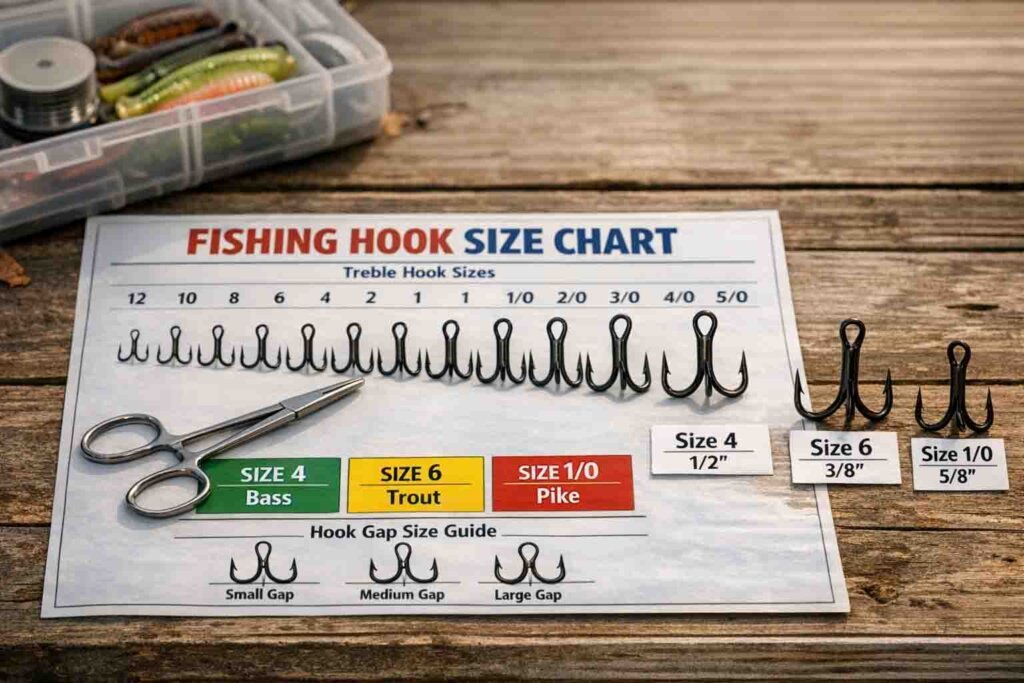
This is also where the hook’s gap (the distance from the point to the shank) is set. This dimension is critically important and is often the missing link when people look at a generic fishing hook size chart. A #4 hook from one factory might have a 6mm gap, while another’s has an 8mm gap. The one with the wider gap will have a higher chance of solid penetration on thick-jawed fish like pike or musky, even though they’re both “size 4.” A professional fishing hook supplier will provide detailed dimensional drawings, not just a size number.
The Heart of Strength & Sharpness: The Hidden Processes
This is where the magic happens—and where cheap manufacturers take the most dangerous shortcuts. The formed hook is still soft and malleable. It needs to be transformed.
Heat Treatment: The Alchemy of Metallurgy
Heat treatment is the process of heating and cooling the steel to change its physical and mechanical properties. For a treble fish hook, we aim for a specific Rockwell Hardness (usually between 55-60 HRC) that provides the ideal “spring.”
- Quenching: The hooks are heated to a precise temperature (around 800-850°C) and then rapidly cooled (quenched) in oil. This makes the steel extremely hard but also brittle.
- Tempering: To reduce the brittleness, the hooks are then re-heated to a lower temperature (200-400°C) and held for a set time. This “draws back” some of the hardness, trading it for toughness.
The exact temperature curves and times are proprietary recipes. Get it wrong by even a small margin, and the hooks will be either too soft (bend easily) or too brittle (snap). We use computerized furnaces with data loggers to ensure every batch follows the exact same profile.
Real-World Test: Our standard “90-Degree Destructive Test” involves clamping the hook shank and bending the point 90 degrees. A properly heat-treated hook will show a consistent, ductile deformation. An under-tempered hook will snap crisply. An over-tempered one will bend like soft wire with no spring-back.
The Science of Sharp: Point Geometry is Everything
“Sharp” is not enough. How it is sharp determines how it penetrates.
- Mechanical Hollow Point (MHP): A cone-shaped grinding wheel cuts a concave, “hollow” point. This creates a strong, chisel-like edge with two cutting surfaces. It’s incredibly durable and excellent for punching through tough fish mouths and resisting damage from structure. This is our go-to for bass, pike, and inshore saltwater treble fish hooks.
- Chemically Sharpened (Needle Point): The hook point is dipped in an acid bath that etches the metal away, leaving an ultra-fine, needle-like point. It is phenomenally sharp and penetrates soft tissue with almost zero pressure. The downside? The fine tip is more susceptible to rolling or dulling on rocks or bones. Ideal for trout, walleye, and open-water applications.
We use automated optical inspection systems to check point angles. Consistency is key—every single point in a batch of 100,000 must be identical.
Inside a Treble Fish Hook Factory: How Quality is Forged (Not Just Made)
Your brand’s reputation hangs by a thread of high-carbon steel. Let’s see what it’s really made of.
The Shield: Corrosion Protection That Actually Works
A perfectly engineered hook is useless if it turns into a brown, rusty blob. The plating room is where we build its armor.
| Plating Type | Process & Appearance | Salt Spray Rating (ASTM B117) | Best Use Case & Cost |
|---|---|---|---|
| Electro-Zinc (Bronze/Gold) | Basic zinc plating. Common, economical. The classic “bronze” hook look. | 24 – 72 hours | Freshwater lures, cost-sensitive models. Low to mid-range. |
| Nickel-Plated | Bright, silvery finish. Good corrosion resistance and smooth finish. | 96 – 120 hours | Premium freshwater, light saltwater use. Mid-range. |
| Black Chrome / Chemical Black | Matte or semi-matte black finish. Excellent hardness and saltwater resistance. | 120 – 200+ hours | High-end saltwater lures, top-tier bass lures. Premium. |
| Epoxy Coating (e.g., Red, Green) | Polymer coating applied over a base plating (usually zinc). Adds physical barrier. | Dramatically extends life of base plating. 200+ hours achievable. | Maximum protection for saltwater, especially over points and bends. Adds cost. |
The Epoxy Truth: That splash of red or green on the hook point isn’t just for marketing. A high-quality epoxy coating locks out moisture and protects the most vulnerable area—the sharpened point itself. The key is adhesion. We perform a cross-hatch adhesion test: a grid is cut into the coating, special tape is applied and ripped off. If any coating comes up, the batch fails.
The Final Gauntlet: Assembly & Quality Control
Automated Assembly: Precision at Scale
For standard treble designs, automated machines align the three single hooks with the split ring or wire form and crimp them together with immense, consistent pressure. Sensors check for missing components or improper crimps. This is where a true fishing hook supplier demonstrates its capability—running these complex machines with minimal downtime and defect rates below 0.1%.
The QC Pyramid: Our Multi-Layer Safety Net
Final inspection is the last line of defense, not the only one. Our system is built on prevention.
- IQC (Incoming Quality Control): Testing raw wire for diameter, tensile strength, and composition.
- IPQC (In-Process Quality Control): Inspectors on the floor, checking samples from every machine every hour. Measuring dimensions, checking point sharpness, visually inspecting plating.
- FQC (Final Quality Control): 100% visual inspection of assembled hooks for obvious defects (broken points, missing plating, malformed eyes).
- OQC (Outgoing Quality Control): Statistical sampling from each finished batch for destructive and non-destructive tests (salt spray, bend test, sharpness gauge).
Putting It All Together: The Real Cost of a Hook
Let’s break down the cost of a typical #4 premium treble hook. This is what you’re actually paying for:
~20%
Raw Material
(High-carbon steel wire)
(High-carbon steel wire)
~45%
“Invisible” Processes
(Heat Treat + Plating)
(Heat Treat + Plating)
~20%
Labor, Overhead & QC
(The human & system cost)
(The human & system cost)
~15%
Grinding & Assembly
(Forming the physical shape)
(Forming the physical shape)
The takeaway is crystal clear: A cheap hook almost always saves money in the 45% “invisible processes” bucket—by using subpar heat treatment, thin or low-grade plating, and slashing the QC budget. They sell you the 20% raw material and 15% shaping, and call it a hook. It looks like one, until it fails.
Inside a Treble Fish Hook Factory: How Quality is Forged (Not Just Made)
Your brand’s reputation hangs by a thread of high-carbon steel. Let’s see what it’s really made of.
Case Study: Turning a Crisis into Confidence
The Problem: A fast-growing European lure brand (let’s call them “Nordic Lures”) was facing an 8% return rate. Anglers were posting videos of their hooks straightening on large pike. Their existing fishing hook supplier blamed “user error.”
The Diagnosis: We received their samples and ran our full battery of tests. The results: inconsistent hardness (from 48 to 62 HRC within the same batch), zinc plating that failed salt spray in under 24 hours, and a hook gap that was 2mm narrower than the standard for that size.
The Solution & Result: We worked with their designer to specify the correct high-carbon steel, a precise heat treatment curve targeting 56-58 HRC, upgraded to a 120-hour nickel plating, and widened the gap according to our optimized fishing hook size chart for pike. We provided them with batch test certificates for every production run.
Within 6 months, their return rate related to hooks dropped to under 1.5%. Their social media transformed from complaint forums to trophy fish photos. Their trust in their component supply chain became a core part of their brand story. This is the power of partnering with a manufacturer, not just a vendor.
3 Common & Costly Buyer Errors (And How to Avoid Them)
- Error: Buying on Price Per Piece Alone.
Solution: Always request samples for destructive testing. Bend them, rust them, compare them side-by-side with a known premium hook. Calculate the cost of failure—a return, a lost customer, a damaged brand—not just the cost per unit. - Error: Assuming “Stainless Steel” is Always Better.
Solution: For most performance applications, specify “heat-treated high-carbon steel with premium anti-corrosion plating.” Demand to see the salt spray test reports for the specific plating type. - Error: Not Defining “Size” Precisely.
Solution: When ordering, provide or request a detailed dimensional drawing. Specify: Wire Diameter, Total Length, Gap (Point to Shank), and Throat (Point to Bend). Don’t just say “#2 Treble.” This turns a generic fishing hook size chart into a precise engineering spec.
Ready to Forge Hooks That Build Your Brand, Not Break It?
Stop guessing and start knowing. Let’s put this knowledge into action.
Get Your Free, No-Obligation Engineering Sample Kit. We’ll send you a physical comparison kit with hooks made to different standards (standard vs. premium heat treat, basic vs. marine plating, etc.) along with their test data. See and feel the difference for yourself.
Request Your Free Sample Kit & Consultation NowTypically responds within 12 hours. No automated replies, just direct contact from our engineering team.

Inside a Treble Fish Hook Factory: How Quality is Forged (Not Just Made)
Your brand’s reputation hangs by a thread of high-carbon steel. Let’s see what it’s really made of.
Your Questions, Answered
What is the actual difference between a $0.03 and a $0.15 treble fish hook?
The 500% price difference is almost entirely in the ‘invisible’ processes. The cheap hook likely uses lower-grade steel with inconsistent or poor heat treatment (leading to brittleness or softness), thin or uneven plating that fails salt spray tests quickly, and minimal quality control. The premium hook invests in precise heat treatment for optimal strength-ductility balance, superior corrosion protection (e.g., 200+ hour salt spray rated plating), and rigorous inspection at every stage. You’re paying for engineering, consistency, and the assurance it won’t fail on a trophy fish.
How can I tell if a fishing hook size chart is accurate for the species I’m targeting?
A good chart provides more than just a number. Look for one that specifies the hook’s ‘gap’ (distance from point to shank) and ‘throat’ (depth). For example, a pike or musky treble needs a wider gap and longer throat than a bass treble of the same ‘size’ number to handle thicker jaw bones. The chart should also note the wire thickness (e.g., standard, 2X strong). Cross-reference the chart with the actual physical samples. If a #4 hook from Supplier A looks and measures vastly different from Supplier B’s #4, their ‘size chart’ is not standardized.
As a startup lure company, what should I prioritize when choosing my first fishing hook supplier?
Prioritize communication and proof over price. A reliable supplier will answer detailed questions about their steel grade, heat treatment process, and QC metrics. They should provide unbiased sample hooks for you to test destructively (bend, rust, sharpness). Request a factory audit report or detailed process photos. Minimum order quantity (MOQ) is secondary; a supplier willing to work with a 5,000-piece pilot order and provide full traceability is worth more than one offering a low price on a 500,000-piece MOQ with no technical support. Your brand’s reputation hinges on component quality.
Is a chemically sharpened treble hook always better than a mechanically sharpened one?
Not always. Chemical sharpening (etching) produces an incredibly sharp, consistent needle point that excels at penetrating soft-mouthed fish like trout or walleye. However, the fine point can roll or dull faster on hard structures. Precision mechanical sharpening (hollow point) creates a stronger, more durable tip geometry ideal for bass, pike, and saltwater species where hitting bone or structure is likely. The ‘best’ method depends on your target species and fishing environment. The key is consistency—every hook in the batch must have the identical point geometry.
Your article mentions salt spray test hours. How many hours are sufficient for freshwater and saltwater lures?
This is critical. For freshwater lures that are dried after use, 24-48 hours of neutral salt spray (ASTM B117) testing is a bare minimum, with 72+ hours indicating good protection. For saltwater lures, you should demand 96 hours minimum, with premium suppliers offering 120 to 200+ hours for their top-tier coatings (like our HKS-200 marine plating). Remember, a 96-hour test doesn’t mean the hook lasts 96 hours in the ocean, but it’s a standardized comparative measure of plating density and corrosion resistance. Always ask for the test report.
References & Further Reading
- ASTM B117-19: Standard Practice for Operating Salt Spray (Fog) Apparatus – The benchmark corrosion test method.
- ASM Handbook, Volume 4: Heat Treating – Authoritative resource on metallurgical processes.
- NOAA Fisheries: Recreational Fishing Trends & Data – For understanding angler demographics and market size (2024 data).