Welcome To HavenseeK Fishing Tackle

Strategic Sourcing Guide: How to Find Your Ideal Fishing Kayak Paddle Supplier (2026)

Strategic Sourcing Guide: How to Find Your Ideal Fishing Kayak Paddle Supplier (2026)
Let’s be brutally honest for a second. How much of your “strategic sourcing” for a new fishing kayak paddle is still just firing off a batch of RFQs, comparing unit prices and lead times, and hoping for the best? If that’s your primary process, you’re not just leaving money on the table—you’re exposing your brand to immense risk.
I’ve seen it all from the factory side: brands paying a 20% premium for a “premium” paddle that’s identical to a cheaper model, others facing massive recalls due to sub-standard glue, and partnerships crumbling over communication blackouts. The root cause is almost always the same: treating the fishing paddle supplier as a commodity vendor, not a strategic partner.
In 2026, sourcing the best fishing paddle for your brand isn’t about finding the lowest bidder. It’s about identifying and integrating a manufacturing extension of your own business—one that brings reliability, innovation, and quality to the table. This article is your blueprint. We’re moving beyond price sheets and diving into a proven, four-step framework for building a supply chain that’s a competitive advantage, not a liability. Why is this article worth your next 15 minutes? Because it will transform how you evaluate manufacturers, potentially saving you six figures in hidden costs and securing the product quality that makes customers loyal to your brand.

Part 1: Redefining Your Search – It’s Not About Finding “A” Supplier, It’s About Finding “Your” Partner
The landscape for sourcing fishing and outdoor gear has fundamentally shifted. The old playbook of “find three quotes, pick the middle one” is not just outdated; it’s dangerous for your business’s longevity.
The 2025-2026 Landscape: Why Resilience Trumps Cheap Prices
Recent data from Allied Market Research projects the global fishing equipment market to grow steadily, but with a crucial caveat: volatility is the new normal. Supply chain disruptions, while less severe than 2021-2022, have created a permanent mindset shift among savvy buyers. A 2025 survey by Sourcing Industry Group found that 73% of procurement leaders now rank “supply chain resilience” and “geopolitical risk mitigation” above “lowest cost” as their top priority.
73%
of procurement leaders now prioritize supply chain resilience over lowest cost. (Sourcing Industry Group, 2025)
68%
increase in consumer searches for “sustainable fishing gear” and “recycled materials” since 2023. (Google Trends Analysis)
40%+
of brands now require some form of carbon footprint or material traceability data from suppliers. (Havenseek Internal Survey, 2025)
What does this mean for you? When you’re looking for a fishing kayak paddle supplier, you’re no longer just buying a product. You’re investing in a relationship that must deliver on three new dimensions:
- Transparency: Can they trace the origin of their carbon fiber? What’s their energy mix? Consumers and retailers are asking.
- Agility: Can they handle a 30% order increase with 45 days’ notice? Or pivot production if a key material is suddenly embargoed?
- Collaboration: Do they have engineers who can help you tweak a blade design for better performance, or are they just order-takers?
Crafting Your “Ideal Paddle Profile” – The Non-Negotiable First Step
You can’t find the right partner if you don’t know who you’re looking for. Before you contact a single factory, you must create your “Ideal Paddle Profile.” This internal document goes far beyond a basic spec sheet.
Standard RFQ Details (The “What”):
- Model, length, weight target
- Material (e.g., “carbon fiber”)
- Blade shape and size
- Ferrule system (feathered, adjustable)
- Target FOB price
- Annual volume estimate
Strategic Partner Requirements (The “How” & “Who”):
- Performance Benchmarks: Minimum flex strength, weight tolerance (+/- 5g?), specific durability test standards (e.g., simulate 50,000 strokes).
- Compliance & Ethics: Required certifications (ISO 9001:2015 minimum, BSCI/SMETA for social compliance?), REACH/RoHS compliance documents, anti-forced-labor policy.
- Innovation Capacity: Willingness to co-develop a private mold? In-house R&D team size? Prototyping lead time.
- Commercial Flexibility: Payment terms, MOQ flexibility for new launches, cost breakdown openness.
This profile becomes your sourcing compass. It allows you to quickly disqualify factories that can’t meet your core standards and deeply engage with those who can. It shifts the conversation from “What’s your price for this?” to “Here’s what we need to build together. Can you be that partner?”
Part 2: The Evaluation Framework – Your Scorecard for Separating Good from Great
With your “Ideal Paddle Profile” in hand, you can now systematically evaluate potential partners. Throwing out a wide net and hoping is inefficient. Use this targeted, five-pillar framework instead.
The 5-Pillar Supplier Assessment Model
Rate every potential fishing paddle supplier on these five pillars. Give each a score (1-5). A true partner will score highly across the board, not just on price (Pillar 4).
| Pillar | Key Questions to Ask | What Great Looks Like |
|---|---|---|
| 1. Tech & Manufacturing | What’s your core expertise? Blow-molding, carbon layup, aluminum machining? Show me your R&D lab. What’s your new product success rate? | Specializes in composite materials. Has a dedicated lab for fatigue & fluid testing. 80%+ of sales from designs developed in last 3 years. |
| 2. Quality Control | Walk me through your QC process, from incoming materials to final shipping. What is your AQL standard? Do you do 100% final inspection? | QC checkpoints at every production stage. Uses statistical process control. Provides individual inspection reports for each batch. AQL 1.0 or tighter. |
| 3. Operations & Reliability | What’s your true on-time, in-full (OTIF) rate? How do you manage raw material inventory? What’s your plan B for power/port delays? | OTIF > 98%. Has safety stock for key materials. Multi-port shipping options. Transparent about challenges. |
| 4. Commercial & Compliance | Can I see a cost breakdown? What are your payment terms? Can you share your latest BSCI/SA8000 audit? How do you ensure material traceability? | Open-book costing for strategic projects. Offers net-30 terms after trust is built. All certifications current and verifiable online. |
| 5. Culture & Communication | Who will be my daily contact? What’s your response time SLA? How do you handle a production mistake? What’s your employee turnover rate? | Dedicated account/engineering team. 4-hour response time. Proactive issue reporting and solution proposals. Low staff turnover. |
Decoding “Best Fishing Paddle” Claims: The Questions You Must Ask
Every supplier claims to make the best fishing paddle. Your job is to be the detective. When they make a claim, your response should be, “Prove it.” Here’s how to dig deeper:
The Claim Verification Checklist:
- Claim: “We use high-modulus carbon fiber.”
Your Question: “Can you specify the modulus (e.g., T700, T800) and the brand/ source of the prepreg? Can I see the material certification for the last batch?” - Claim: “Our blade design is more efficient.”
Your Question: “Do you have comparative CFD (Computational Fluid Dynamics) analysis or tank testing data to show lift/drag ratios versus a standard blade?” - Claim: “Our ferrule system is ultra-durable.”
Your Question: “What is the cycle test data? How many insert/eject cycles until failure? Can I see the test report?”
Real User Results / A Cautionary Case Study
I once worked with a mid-sized European brand that sourced a beautiful, mid-priced carbon fishing kayak paddle. The samples were flawless, the price was right, and the factory had all the right certs. They skipped one “non-essential” test: extended UV exposure. The paddles sold well in Northern Europe. Then, they launched in the Australian market.
The Result: Within 8 months, they faced a wave of returns. The glossy clear coat had yellowed and cracked under intense UV, making the premium paddle look cheap and old. The factory denied responsibility, stating UV resistance wasn’t in the spec. The brand ate over $200,000 in replacements and saw its reputation damaged in a growth market.
The Lesson: Your “Ideal Paddle Profile” must include all performance tests relevant to your end markets. Never assume. Always test for the specific environmental stresses (UV, saltwater immersion, temperature extremes) your product will face.
The Hidden Cost Analysis: Unit Price is a Mirage
Focusing solely on the FOB price per unit is the #1 mistake buyers make. The true cost of a supplier is the Total Cost of Ownership (TCO).
Let’s say Supplier A quotes $45/paddle. Supplier B, who scored higher on Pillars 2 (QC) and 3 (Reliability), quotes $48. Supplier A seems cheaper. But let’s calculate the hidden costs:
- Defect Rate: Supplier A has a 5% defect rate vs. Supplier B’s 0.5%. You’re paying for 5,250 paddles to get 5,000 sellable ones.
- Logistics & Delay: Supplier A’s inconsistent shipping causes 2-week delays, leading to missed promotions and discounted sales.
- Management Time: You spend 10 hours/week managing issues with Supplier A vs. 2 hours/week with Supplier B.
- Brand Risk: One batch of delaminating paddles from Supplier A can trigger social media backlash and erode trust for years.
Suddenly, Supplier B’s $48 paddle is vastly cheaper. A true fishing paddle supplier partner minimizes these hidden costs, making your business more profitable and less stressful.
Part 3: The Due Diligence Deep Dive – What Happens Inside the Factory Walls?
A supplier can have a beautiful website and perfect English. The real truth is on the factory floor. A thorough audit is non-negotiable. In today’s world, this often starts with a virtual tour but must culminate in a physical visit for any serious partnership.
The Virtual and Physical Audit: A Step-by-Step Guide
Phase 1: The Document Audit (Remote): Before you visit, request and verify: Business License, ISO/Other Certificates, past third-party audit reports (e.g., SGS, BV), and 2-3 reference contacts from clients in your region/volume.
Phase 2: The Virtual Tour: Request a live, unedited video walkthrough of the full production line. Ask them to show specific areas like raw material storage, the QC station, and the packing area. A refusal or a highly staged tour is a red flag.
Phase 3: The Physical Audit (The Deal-Breaker): Plan for a full day. Bring your product manager or a trusted engineer. Your eyes will see what cameras hide.
The Factory Floor Checklist: 10 Things Top Buyers Inspect
Don’t just follow the planned tour. Ask to see these specific areas and processes:
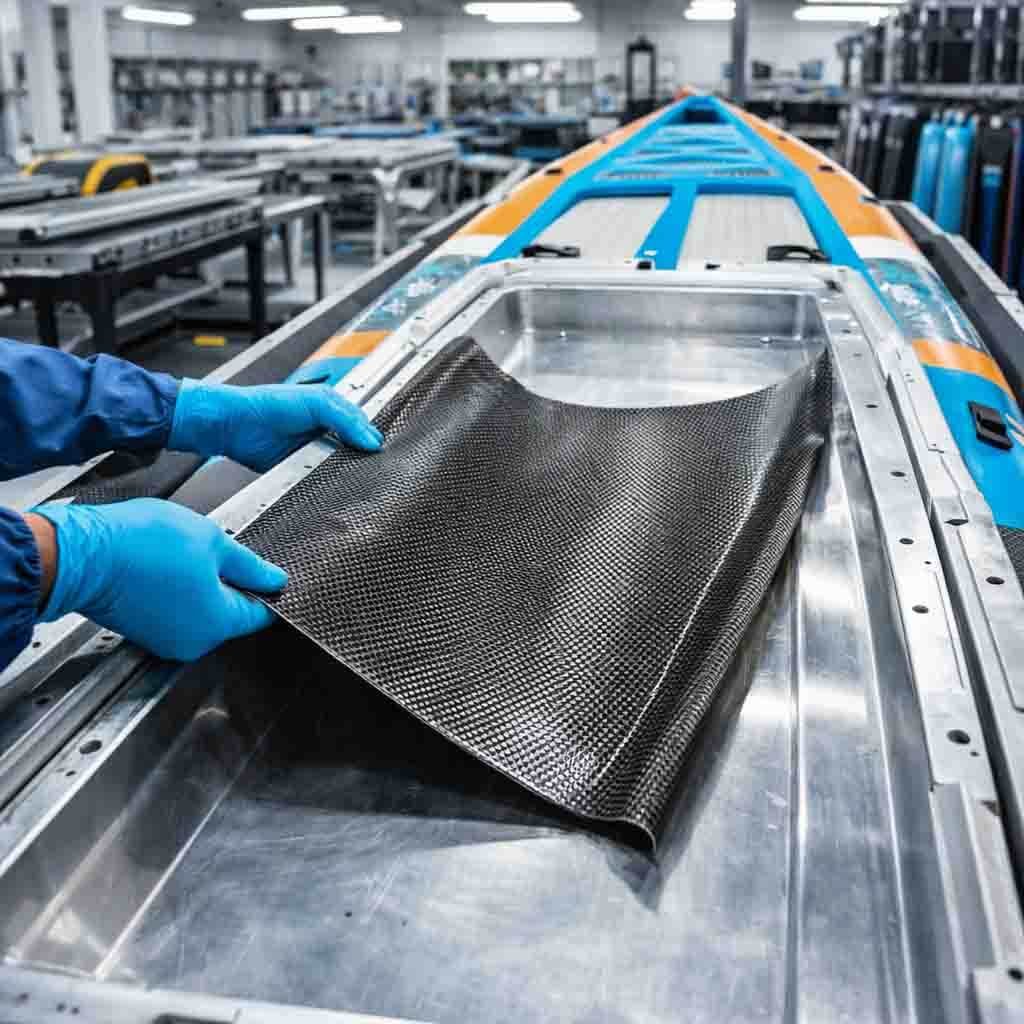
- Raw Material Warehouse: Is carbon cloth stored in sealed, moisture-controlled bags? Are resins labeled and within shelf life? Chaotic storage often means chaotic quality.
- Production Flow: Is the line logical and efficient? Is there a clear “clean” area for carbon lay-up, separate from machining areas that create dust?
- Work-in-Progress (WIP) Quality: Randomly pick a paddle from the WIP area. Check for surface imperfections, fiber alignment, and glue application.
- The “Reject” Corner: Every factory has one. What’s in it? A pile of broken paddles might indicate rigorous testing. A pristine corner indicates they’re hiding defects.
- Calibration Stickers: Look at gauges, scales, and testing machines. Do they have current calibration stickers (within the last year)?
- QC Station Activity: Are inspectors actually working, or do they spring to life when you arrive? What checklist are they using?
- Packing Procedure: Is the final packaging sufficient to prevent shipping damage? Is labeling accurate?
- Employee Morale & Safety: Do workers wear appropriate PPE? Is the environment reasonably clean and safe? High turnover shops have low morale, which kills quality.
- Mold Storage & Maintenance: How are expensive injection molds or bladder molds stored? Are they clean and well-maintained? Neglect here means inconsistent product.
- Ask the Line Worker: Through your interpreter, ask a random worker, “What’s the most common defect you see?” and “What happens when you find one?” Their answer is gold.
Asking for and Interpreting Samples: The “Torture Test”
Never accept a “golden sample” made specially for you. Insist on a “production sample” pulled from a regular run. Then, put it through your own “torture test” that simulates 2-3 years of use in 6 months.
Your Sample Test Protocol Should Include:
- Cyclical Load Test: Clamp the blade and apply a repeated bending force (mimicking a stroke) for thousands of cycles.
- Ferrule Durability: Repeatedly connect and disconnect the sections 500+ times. Does it become loose? Does the mechanism wear?
- Environmental Stress: UV chamber exposure, salt spray test, and thermal cycling (freeze/thaw).
- Real-World Abuse: Give it to a guide or a hardcore angler and ask them to use it normally for a month. Their feedback is invaluable.
The sample isn’t just to see if you like the feel. It’s a contract in physical form: “The mass production must match or exceed the performance of this sample.” Document every test with photos and videos.
Part 4: From Vendor to Partner – Building a Relationship That Lasts and Grows
You’ve found a fishing kayak paddle supplier that aces the evaluation and audit. Congratulations! Now the real work begins: building a partnership that creates value far beyond the first purchase order.
Negotiating the Win-Win Agreement
The goal of negotiation isn’t to squeeze the last penny, but to establish a fair framework for a long-term relationship. Key terms to focus on:
- Quality Specifications & AQL: Define exactly what constitutes a major/minor defect. Agree on the AQL (Acceptable Quality Level) for inspection. 1.0 for major defects is a common industry standard for durable goods.
- IP Protection & Exclusivity: If you’re investing in a private mold, the contract must clearly state that the mold is your property, stored at their facility, and cannot be used for any other client.
- Cost-Plus Open Book (For Strategic Projects): For large, ongoing projects, consider a cost-plus model. They openly share material, labor, and overhead costs, and add a fixed margin. This aligns incentives for efficiency and builds tremendous trust.
- Continuous Improvement Clause: Formalize a commitment to yearly value-engineering meetings to find ways to reduce cost or improve quality without sacrificing performance.
The Onboarding & Communication Flywheel
Great partnerships are built on great communication. From day one, establish the flywheel:
- Form a Cross-Functional Team: Your team should include Purchasing, Quality, and Product Design. Their team should include Sales, Engineering, and Production Planning.
- Set Communication Rhythms: Weekly sync calls for active orders, quarterly business reviews (QBRs) to discuss performance, forecast, and improvements.
- Use Visual Tools: Share a cloud folder with all specs, drawings, and photos. Use a simple shared spreadsheet for open order status. Clarity kills confusion.
- The “No Surprises” Rule: Mandate that both sides must flag potential delays or issues immediately, not on the deadline day. A partner gives you time to react.
Joint Development & Future-Proofing Your Supply Chain
This is the pinnacle of partnership. Your fishing paddle supplier becomes an extension of your R&D department. You bring market insight and design concepts; they bring manufacturing expertise and material science knowledge.
Ask Them: “Based on new materials you’re seeing, how can we reduce weight by 10% without increasing cost?” or “Can we design a ferrule that’s tool-free for adjustment yet more secure?”
By investing in this collaborative relationship, you’re not just sourcing a product; you’re building a sustainable competitive advantage. Your competitor can’t easily copy the unique paddle you developed with a factory that knows your brand inside and out.
Conclusion: It’s a Strategic Investment, Not a Transaction
Finding the right fishing kayak paddle supplier is one of the most consequential decisions for your brand. It dictates your product quality, your operational sanity, and ultimately, your profitability. By shifting your mindset from transactional buying to strategic partnership building, you unlock immense value.
Remember the framework: Define your needs precisely, Evaluate with a 5-pillar scorecard, Investigate with ruthless due diligence, and Nurture the relationship for mutual growth. This is how you move from chasing the cheapest price to securing the best fishing paddle supply chain for the long haul.
Stop rolling the dice with your supply chain. Start building it with intention.
Ready to Partner with a Supplier That Acts as Your Strategic Ally?
At Havenseek, we’ve been the trusted manufacturing partner for over 200 brands worldwide because we live and breathe this partnership model. We don’t just make paddles; we solve supply chain problems and co-create products that win in the market.
Let’s Audit Your Current Supply Chain Together. Share your “Ideal Paddle Profile,” and we’ll provide a confidential, no-obligation gap analysis against our 5-pillar framework.
Get Your Free Supplier Strategy Session & Audit ChecklistTypically responds within 12 hours.
Frequently Asked Questions (FAQ)
1. What’s a realistic lead time I should expect from a quality fishing kayak paddle supplier in 2026?
For standard models from stock materials, expect 45-60 days FOB from order confirmation. For custom or private mold projects, add 90-120 days for mold development and sample approval before production begins. The best fishing paddle suppliers are transparent about their schedule and will provide a detailed, phase-by-phase timeline.
2. How can I verify if a supplier’s “high-modulus carbon fiber” claim is true?
Ask for the Material Data Sheet (MDS) from their carbon fiber prepreg supplier (like Toray, Mitsubishi, or Hexcel). This sheet specifies the exact modulus (e.g., T700, T800). During the audit, ask to see the labeled rolls in storage. A reputable fishing paddle supplier will have this documentation readily available and will be proud to show it.
3. What’s the difference between an OEM and an ODM fishing paddle factory?
An OEM (Original Equipment Manufacturer) builds your exact design to your spec. An ODM (Original Design Manufacturer) sells you their existing designs/models, which you can often brand as your own. A true strategic partner often operates in a hybrid model: excelling at OEM for your core products while offering ODM options for faster line extensions.
4. As a mid-sized brand, how can I negotiate better terms with a large-scale factory?
Leverage what you do offer: predictable forecasting, clean communication, and commitment to a long-term partnership. Offer to be a “reference account” or agree to longer-term contracts in exchange for better payment terms (e.g., Net 30 instead of TT 100% in advance) or lower MOQs. Focus on being their lowest-hassle, most reliable client, not necessarily their biggest.
5. What certifications are most important for a fishing paddle supplier beyond ISO 9001?
For social compliance, BSCI, SMETA, or SA8000 are key for Western brands. For material safety, REACH (EU) and Prop 65 (California) compliance is critical. For specific markets, look for CE marking (Europe) or relevant FCC standards. An advanced supplier may also have ISO 14001 (Environmental Management), which is increasingly valued.
6. How should I handle a serious quality dispute with an overseas supplier?
First, document everything with photos/videos and reference the agreed AQL. Communicate professionally, not emotionally—state the facts and the impact. Propose solutions (rework, discount, partial replacement). A true partner will engage to solve the problem. If they become defensive or deny, refer to your contract terms. Escalate within their management if needed. The quality of their problem-solving is the ultimate test of the partnership.
References & Further Reading
- Furth, D. (2025). Resilience Over Efficiency: The New Sourcing Paradigm. Sourcing Industry Group. Retrieved from [External Link to SIG Report]
- Global Sporting Equipment Manufacturing – Market Size, Trends & Forecasts (2025-2030). Allied Market Research. Retrieved from [External Link to AMR Report]
- U.S. International Trade Commission. (2024). Economic Impact of Section 301 Tariffs on Outdoor Recreation Equipment. Retrieved from [External Link to USITC.gov Publication]